By: Donald L Swanson
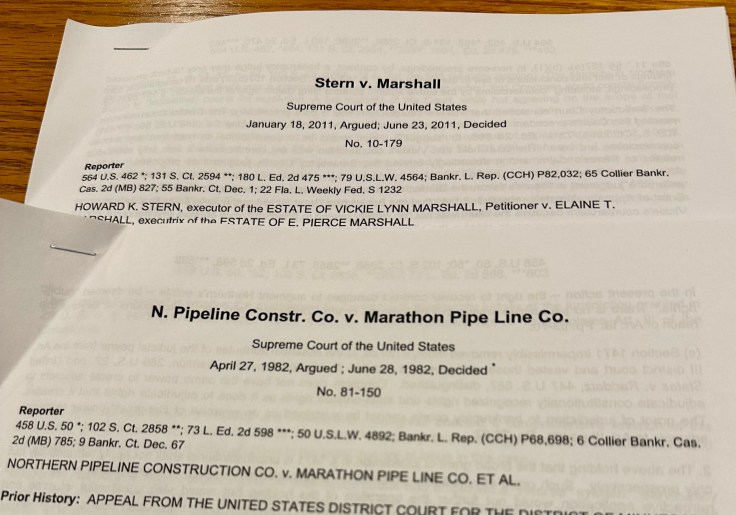
Stern v. Marshall, 564 U.S. 462 (2011), is a five-justice majority opinion with a four-justice dissent.
And the dissent is strong. Too bad it failed to prevail, because:
- the majority opinion created havoc within the entire bankruptcy system; and
- it did so by creating uncertainty, confusion and mystery about the nature and extent of bankruptcy court authority.
What follows is a summary of portions of the Stern v. Marshall dissent.
Background
Pierce Marshall filed a proof of claim in Bankruptcy Court against the bankruptcy estate of Vickie Marshall (a/k/a Anna Nicole Smith), asserting that Vickie Marshall had, through her lawyers, accused him of trying to prevent her from obtaining money that his father had wanted her to have; that her accusations violated state defamation law; and that she consequently owed Pierce Marshall damages.
Vickie Marshall filed a compulsory counterclaim, in which she asserted that Pierce Marshall had unlawfully interfered with her husband’s efforts to grant her an inter vivos gift and that Pierce Marshall consequently owed her damages.
The Bankruptcy Court adjudicated both the claim and the counterclaim. In doing so, the court followed statutory procedures applicable to “core” bankruptcy proceedings under 28 U.S.C. § 157(b).[Fn. 1] And ultimately the Bankruptcy Court entered judgment in favor of Vickie Marshall.
The question before us is whether the Bankruptcy Court possessed jurisdiction to adjudicate Vickie Marshall’s counterclaim against Peter Marshall. The majority declares such jurisdiction unconstitutional.
I disagree.
Summary of Dissent
In the dissent’s view, the majority:
- overstates the current relevance of statements this Court made in an 1856 case (Murray’s Lessee v. Hoboken Land & Improvement Co., 59 U.S. 272 (1856)) and in Northern Pipeline Constr. Co. v. Marathon Pipe Line Co., 458 U.S. 50 (1982);
- understates the importance of a watershed opinion (Crowell v. Benson, 285 U.S. 22 (1932)); and
- fails to follow the analysis this Court more recently made in Thomas v. Union Carbide Agricultural Products Co., 473 U.S. 568 (1985), and Commodity Futures Trading Comm’n v. Schor, 478 U.S. 833 (1986).
–Murray’s Lessee
Murray’s Lessee has been used to uphold non-Article III adjudication—not to strike it down. The one exception is Northern Pipeline, where the Court struck down the Bankruptcy Act of 1978. But in Northern Pipeline there was no majority, and the effect of its plurality opinion was narrowed, three years later, in Thomas.
–Crowell
Crowell is a seminal case on Congress’s grant to an Article I administrative agency authority to adjudicate an employee’s workers’ compensation claim against the employer. This Court assumed that an Article III court would review the agency’s decision de novo on questions of law but under a clear error standard on questions of fact. This Court found constitutional the statute’s delegation of adjudicatory authority to the agency.
–Thomas & Schor
Thomas and Schor each command a clear majority, in which this Court took a pragmatic approach—seeking to determine whether the challenged action posed a serious threat of one branch of Government aggrandizing itself by encroaching upon the authority assigned by the Constitution to another branch.
In Thomas, this Court said, “practical attention to substance rather than doctrinaire reliance on formal categories should inform application of Article III,” indicating that “we do not think this system threatens the independent role of the Judiciary in our constitutional scheme.”
Schor is a customer’s reparations claim against a commodity broker, along with the broker’s counterclaim for contract damages against customer, being heard by a governmental agency. In deciding whether the governmental agency could resolve the counterclaim, the Supreme Court “declined to adopt formalistic and unbending rules,” “weighed a number of factors,” and upheld the agency’s authority to adjudicate the entire dispute under normal standards of review by an Article III appellate court.
–Dissent’s Conclusion
The dissent declares, based on its analysis of the precedents:
- “the delegation of adjudicatory authority before us is constitutional”; and
- “A grant of authority to a bankruptcy court to adjudicate compulsory counterclaims does not violate any constitutional separation-of-powers principle related to Article III.”
Consent
Four years later, the U.S. Supreme Court issues a “consent” clarification on bankruptcy court jurisdiction to resolve the types of claims declared unconstitutional in Stern v. Marshall:
- “in Stern, this Court held that Congress violated Article III by authorizing bankruptcy judges to decide certain claims for which litigants are constitutionally entitled to an Article III adjudication”;
- “This case presents the question whether Article III allows bankruptcy judges to adjudicate such claims with the parties’ consent”;
- “We hold that Article III is not violated when the parties knowingly and voluntarily consent to adjudication by a bankruptcy judge”; and
- the consent may be either “express or implied.”
Wellness International Network, Ltd. V. Sharif, 575 U.S. 665, 669 & 685(2015).
With such Wellness ruling in mind, note this information from the Stern v. Marshall dissent:
- “the parties have consented to Bankruptcy Court jurisdiction,” and such consent “argues in favor of constitutionality, and strongly so”;
- “Pierce Marshall, the counterclaim defendant, is not a stranger to the litigation, forced to appear in Bankruptcy Court against his will”:
- “he appeared voluntarily in Bankruptcy Court as one of Vickie Marshall’s creditors, seeking a favorable resolution of his claim against Vickie Marshall to the detriment of her other creditors;
- “He need not have filed a claim, . . . for he says his claim is ‘nondischargeable,’ in which case he could have litigated it in a state or federal court after distribution”;
- the absence of consent to “an initial adjudication before a non-Article III tribunal was relied on [in Northern Pipeline] as a significant factor in determining that Article III forbade such adjudication”; and
- “filing a proof of claim” was sufficient for consent in Langenkamp and Granfinanciera, and “there is no relevant distinction between the claims filed in those cases and the claim filed here.”
564 U.S. at 515-16 (emphasis added).
Conclusion
Too bad the Stern v. Marshall four-justice dissent failed to prevail. We could have skipped all the confusion and uncertainty and mystery and havoc that Stern v. Marshall’s majority opinion created.
Note: this is the fifth of a five-articles series on Northern Pipeline and Stern. I hope you have enjoyed the series.
——————————-
Footnote 1. The portion of 28 U.S.C. § 157(b) that applies here says: “(1) Bankruptcy judges may hear and determine all cases under title 11 and all core proceedings arising under title 11, or arising in a case under title 11, referred under subsection (a) of this section, and may enter appropriate orders and judgments, subject to review under section 158 of this title. (2) Core proceedings include, but are not limited to— . . . (C) counterclaims by the estate against persons filing claims against the estate” (emphasis added). The holding of Stern v. Marshall is that the grant of jurisdiction, in 28 U.S.C. § 157(b)(2)(C) over counterclaims founded on state law is unconstitutional.
** If you find this article of value, please feel free to share. If you’d like to discuss, let me know.


Leave a Reply