By: Donald L Swanson
The Bankruptcy Code’s effective date was October 1, 1979. Northern Pipeline Construction Co. filed Chapter 11 bankruptcy in January of 1980, under the new Bankruptcy Code.
In its bankruptcy, Northern Pipeline sued Marathon Pipe Line Co. in bankruptcy court, asserting claims under state law.
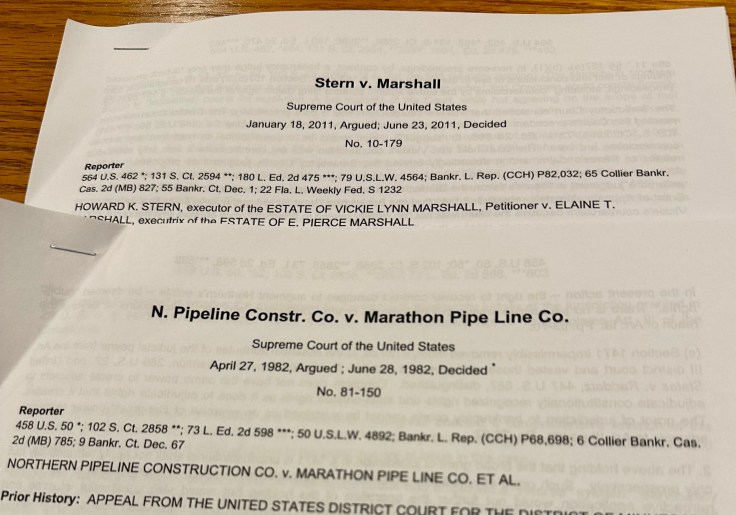
The question of bankruptcy court jurisdiction to hear and resolve that lawsuit found its way to the U.S. Supreme Court, in Northern Pipeline Construction Co. v. Marathon Pipe Line Co., 458 U.S. 50 (1982). The Supreme Court declared that the Congressional grant of authority to the bankruptcy court to hear Northern Pipeline’s lawsuit was unconstitutional.
Such declaration is the result of a plurality opinion (consisting of a four-justice lead opinion and a two-justice concurring opinion) that does two things: (i) creates a six-justice controlling decision, and (ii) narrows the extent of the unconstitutionality declaration to the dispute at hand.
The Northern Pipeline v. Marathon result threw the entire bankruptcy system into confusion for a long time.
But that confusion did not need to happen, as shown by a compelling three-justice dissent in Northern Pipeline v. Marathon. What follows is a summary of a portion of that dissent.
Article III
Article III, § 1, of the Constitution is straightforward and uncomplicated on its face:
- “The judicial Power of the United States, shall be vested in one supreme Court, and in such inferior Courts as the Congress may from time to time ordain and establish”; and
- “The Judges, both of the supreme and inferior Courts, shall hold their Offices during good Behaviour, and shall at stated Times, receive for their Services, a Compensation, which shall not be diminished during their Continuance in Office.”
Article III language appears to be clear and straightforward. But how it is to be applied is one of the most confusing and controversial areas of constitutional law.
Plurality Decision
The plurality decision is grounded in these points:
- non-Art. III judges may consider only controversies arising out of federal law; and
- because the controversy in Northern Pipeline’s claim against Marathon arises out of state law, it can only be adjudicated by an Art. III court—not by a bankruptcy court.
The plurality concedes that Congress may provide for initial adjudications by bankruptcy courts of all rights and duties arising under federal laws.
But the plurality attempts to distinguish the Northern Pipeline dispute by contending that the bankrupt’s claim against Marathon arose under state law. Non-Article III judges, in its view, cannot be vested with authority to adjudicate such claims.
That plurality’s distinction is unsupportable for three reasons.
First, bankruptcy is an exercise of federal law that bankruptcy courts can adjudicate.
The plurality concedes that (i) “the restructuring of debtor-creditor relations” is “at the core of the federal bankruptcy power,” and (ii) “the manner in which the rights of debtors and creditors are adjusted” is a matter of federal law, which can be resolved by bankruptcy courts.
Second, bankruptcy courts adjudicate state law claims all the time.
The routine in ordinary bankruptcy cases has always been to, (i) stay actions against the bankrupt, (ii) collect the bankrupt’s assets, (iii) require creditors to file claims or be forever barred, (iv) allow or disallow claims that are filed, (v) adjudicate preferences and fraudulent transfers, and (vi) make pro rata distributions to creditors, who will be barred by the discharge from taking further actions against the bankrupt.
The crucial point is that the great bulk of creditor claims arise under state law (i.e., claims for goods sold, wages, rent, utilities, and the like):
- every such claim must be filed, and its validity is subject to adjudication by the bankruptcy court; and
- hence, bankruptcy judges have always been enmeshed in and have always adjudicated state-law issues.
The new aspect of the Bankruptcy Code is not the extension of federal jurisdiction to state-law claims, it is the extension of federal jurisdiction to particular kinds of state-law claims (i.e., to contract claims against third parties).
Third, the plurality’s separation-of-powers doctrine is misapplied.
The plurality bases its no-jurisdiction result on the separation-of-powers doctrine. But the plurality’s analysis turns that doctrine on its head. Here’s why:
- state law claims would ordinarily not be heard by Art. III judges—they would be heard by state judges, absent diversity jurisdiction; and
- so, there is little danger of a diminution of, or intrusion upon, the power of Art. III courts, when state law claims are assigned to a non-Art. III court.
The plurality misses this obvious point because it concentrates on explaining how it is that federally created rights can ever be adjudicated in Art. I courts—a far more difficult problem under the separation-of-powers doctrine.
The plurality fumbles when it assumes that the rationale it develops to deal with federally created rights in bankruptcy courts must also govern the problem of state law claims in bankruptcy. In fact, the two are simply unrelated, and the plurality never really explains the separation-of-powers problem in assigning state-law questions to bankruptcy courts.
Practice Under Prior Bankruptcy Act
Even prior to the new Bankruptcy Code, bankruptcy cases were generally referred to bankruptcy judges (previously called referees) who possessed complete jurisdiction of the bankruptcy proceedings and would hear and decide practically all matters arising in the proceedings, including the allowance and disallowance of creditor claims.
All of such matters could and usually did involve state-law issues. Initial adjudication of state-law issues by non-Art. III judges is, then, hardly a new aspect of the new Bankruptcy Code.
Indeed, we approved the authority of the bankruptcy judge to allow or disallow claims in Katchen v. Landy, 382 U.S. 323 (1966), where the bankruptcy judge held that a creditor received a preference and, therefore, its claim must be disallowed. We agreed that the bankruptcy judge had the authority not only to adjudicate the existence of the preference, but also to order that the preference be disgorged.
We also recognized that the bankruptcy judge could adjudicate counterclaims against a creditor who files a claim against the bankruptcy estate. Hence, under the former bankruptcy law, if Marathon had filed a proof of claim in the bankruptcy case, the trustee could have filed and the bankruptcy judge could have adjudicated the counterclaim seeking the state-law relief requested here.
Of course, all such adjudications by a bankruptcy judge, under the old law, were subject to review in the district court (an Art. III court), on the record and with the bankruptcy judge’s findings of fact scrutinized for clear error. Bankruptcy Rule 810, transmitted to Congress by this Court, so provided.
In other words, under both the old and new bankruptcy laws, initial determinations of state-law questions were to be made by non-Art. III judges, subject to appellate review by Art. III judges. And why the differences in the provisions for appeal in the two bankruptcy laws are of unconstitutional dimension remains entirely unclear
Conclusion
Too bad the three-justice dissent did not prevail in Northern Pipeline v. Marathon!
Note: this is the fourth of a five-articles series on Northern Pipeline and Stern.
** If you find this article of value, please feel free to share. If you’d like to discuss, let me know.


Leave a Reply