By: Donald L Swanson
The U.S. Supreme Court has never liked like the Bankruptcy Code and has worked diligently, over the decades, to limit the authority of bankruptcy courts and bankruptcy judges.
Two examples are U.S. Supreme Court opinions that have anniversaries this month—in June of 2026:
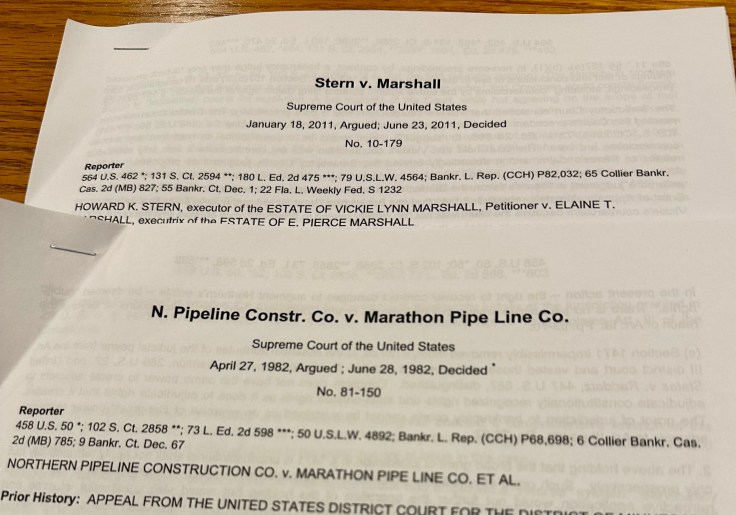
- 44 years ago (on June 28, 1982), the Supreme Court issued its Northern Pipeline v. Marathon Pipe Line opinion; and
- 15 years ago (on June 23, 2011), the Supreme Court issued its Stern v. Marshall opinion.
Northern Pipe Line v. Marathon Pipeline
October 1, 1979, is the effective date of today’s Bankruptcy Code, which granted bankruptcy courts and judges jurisdiction over all “civil proceedings arising under title 11 or arising in or related to cases under title 11” (28 U.S.C. § 1471).
In January of 1980, Northern Pipeline Construction Co. files a voluntary petition under Chapter 11 of the newly-effective Bankruptcy Code.
In March of 1980, Northern Pipeline as debtor in possession sues Marathon Pipe Line in Bankruptcy Court to recover damages for breaches of contract and warranty, misrepresentation, coercion and duress.
Marathon Pipe Line moves to dismiss the lawsuit on grounds that the Bankruptcy Code unconstitutionally confers Art. III judicial power upon bankruptcy judges who lack life tenure and protection against salary diminution. The Bankruptcy Court denies the motion.
On appeal, the District Court reverses and grants the motion because, “the delegation of authority in 28 U.S.C. § 1471 to the Bankruptcy Judges to try cases which are otherwise relegated under the Constitution to Article III judges” is unconstitutional.
Northern Pipeline appeals directly to the U.S. Supreme, which grants certiorari and produces this result:
- four justices declare unconstitutional the entire grant of jurisdiction to bankruptcy courts, in 28 U.S.C. § 1471, as having “impermissibly removed most, if not all, of the essential attributes of the judicial power from the Art. III district court” and “vested those attributes in a non-Art. III adjunct” (458 U.S. at 90);
- two justices concur in the result, creating a plurality but with a much narrower effect—addressing constitutionality of only the specific Northern v. Marathon issue before it—because the Court should never “formulate a rule of constitutional law broader than is required by the precise facts to which it is applied” (id.); and
- three justices dissent saying, (i) “under both the old and new Acts, initial determinations of state-law questions were to be made by non-Art. III judges, subject to review by Art. III judges”, and (ii) “Why the differences in the provisions for appeal in the two Acts are of unconstitutional dimension remains entirely unclear” (458 U.S. at 100).
Congressional Response
In 1984 and in response to Northern Pipeline, Congress replaces 28 U.S.C. § 1471 with 28 U.S.C. § 157, which:
- gives bankruptcy courts jurisdiction over “all cases under title 11 and all core proceedings arising under title 11, or arising in a case under title 11, referred under subsection (a) of this section”;
- establishes the “proposed findings of fact and conclusions of law” structure for handling non-core disputes; and
- provides that bankruptcy courts “may enter appropriate orders and judgments, subject to review under section 158 of this title.”
All Seemed Well
For the next quarter century and more, questions of bankruptcy court jurisdiction remain dormant. And the bankruptcy bench and bar, during that time, come to believe that such jurisdiction questions are settled and that all is well on the bankruptcy jurisdiction front.
But no. Surprise, surprise!
Public Rights Doctrine
In 2011, the U.S. Supreme Court wades in again on bankruptcy court jurisdiction issues—in Stern v. Marshall—and throws everything into a tailspin by introducing the Public Rights Doctrine into the bankruptcy court jurisdiction analysis.
Outside of bankruptcy, the Public Rights Doctrine is used to justify grants of judicial authority to federal regulatory agencies for resolving disputes within their regulatory realm—despite the requirements of Article III.
And Northern Pipeline had made short-shrift of the Public Rights Doctrine for bankruptcy court jurisdiction:
- by declaring that “a matter of public rights must at a minimum arise between the government and others” (458 U.S. at 69); and
- in the Northern Pipeline v. Marathon Pipe Line dispute, there was no government involvement at all.
So, we had all thought, back then, that the Public Rights Doctrine was dead in bankruptcy—had little-to-nothing to do with bankruptcy disputes—because of the Northern Pipeline declaration that the Public Rights Doctrine can only apply when a dispute is with the U.S. Government.
But Stern v. Marshall changes that idea—tosses it on its head.
Stern v. Marshall
Stern v. Marshall involves a state law counterclaim asserted in bankruptcy court by a non-debtor in response to an objection to that non-debtor’s proof of claim. The Supreme Court rules that the bankruptcy court could not resolve the state law counterclaim because only private rights, and no public rights, were involved.
In Stern v. Marshall, it appeared that the U.S. Supreme Court was trying to create a unified theory of bankruptcy court jurisdiction—a theory that would explain why bankruptcy courts:
- could adjudicate bankruptcy-core matters (e.g., recovering and liquidating assets, resolving claims disputes, and distributing money) under a deferential standards of appellate review; but
- could not adjudicate related matters against non-debtor parties on state law claims.
To the extent the Supreme Court was trying to create a unified theory, it failed miserably!
What it did, instead, was create confusion and uncertainty. These statements in Stern, for example, opened a new-world of mystery:
- we have “rejected the limitation of the public rights exception to actions involving the Government as a party”; and
- the Public Rights Doctrine now “derives from a federal regulatory scheme” that is “integrally related to particular Federal Government action” (564 U.S. at 499).
“What the heck?!” That was a common reaction among the bankruptcy bench and bar, when Stern v. Marshall came down. “We now have to divine what ‘integrally related’ to Government action means”?!
Wonderings, back then, include:
- does the involvement of the U.S. Trustee’s Office in a dispute make that dispute “integrally related” to Government action?
- when the U.S. Government is a creditor in a Chapter 7 bankruptcy case, are the Chapter 7 trustee’s actions “integrally related” to Government action?
- and if so, how about actions of the debtor in possession?
Practical Realities
But much of the Stern-caused confusion and uncertainty prove to be, ultimately, for naught. Time and necessity often resolve many problems. And that is what happens here.
As it turns out, through Congressional action and additional Supreme Court rulings, the combined meaning and effects of Northern Pipeline v. Marathon Pipe Line and Stern v. Marshall are limited and simple. It’s this—bankruptcy courts:
- can resolve all bankruptcy-type issues (i.e., “core” proceedings—see 28 U.S.C. § 157), under the “clearly erroneous” standard of appellate review for findings of fact; and
- can address other types of issues relating to a bankruptcy case (including disputes under state law), but only:
- with a de novo review of all findings and conclusions (referred to as “proposed findings of fact and conclusions of law” in 28 U.S.C. § 157); or
- upon the express or implied consent of the parties (see Wellness International—a 2015 bankruptcy jurisdiction opinion, in which the majority fail to even mention the Public Rights Doctrine).
The ultimate result of time and necessity is that we have no unified theory of bankruptcy court jurisdiction. What we have, instead, is the practical result of all that has happened over the past 44 years.
Conclusion
Bankruptcy law ran amok for a very long time.
That’s the combined effect of Northern Pipeline v. Marathon Pipe Line and Stern v. Marshall.
Note: this is the third of a five-articles series on Northern Pipeline and Stern.
** If you find this article of value, please feel free to share. If you’d like to discuss, let me know.


Leave a Reply