By: Donald L Swanson
Here is a common statement of bankruptcy court jurisdiction: “The Court has constitutional authority to determine this matter because it,”
- “is purely a matter of bankruptcy law”; and
- “does not require the resolution of any matter similar to ‘the stuff of the traditional actions at common law tried by the courts at Westminster in 1789’” (emphasis added).
Authorities commonly cited in support of such statements are:
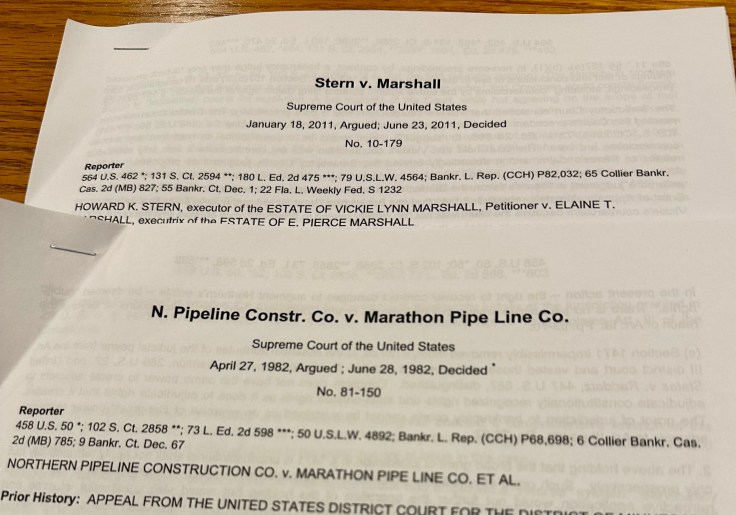
- Stern v. Marshall, 564 U.S. 462, 484 (2011); and
- Northern Pipeline Constr. Co. v. Marathon Pipe Line Co., 458 U.S. 50, 90 (1982) (concurring in judgment).
I’ve always been fascinated by such references to a far-away and long-ago place and time as the basis for today’s limitations on authority of bankruptcy courts. So, I decided to look into the bankruptcy history of “courts at Westminster in 1789,” and here is what I found.
1789
The significance of the year 1789 is its proximity to the ratification of the U.S. Constitution. According to this U.S. Senate site, the U.S. Constitution was, “Written in 1787, ratified in 1788, and in operation since 1789.”
Hence, the year for determining the facts at issue is the year the U.S. Constitution went into operation.
“Stuff” Tried by “Courts at Westminster”
What are the “traditional actions at common law” that are the “stuff” tried by courts at Winchester?
Ummm . . . that’s not easy to find.
The first U.S. Supreme Court opinion I could find that uses the phrase, “Courts at Westminster,” is from 1799: Turner v. Bank of North America, 4 U.S. 8 (1799). The Turner opinion deals with diversity of citizenship jurisdiction of a U.S. federal court over a suit on a promissory note — and diversity of citizenship does not exist in Turner. The opinion says that a federal court‘s proceedings are not “subject to the scrutiny of those narrow rules which the caution or jealousy of the courts at Westminster long applied” (4 U.S. at 11).
In 1939, Justice Frankfurter authors a concurring opinion, citing “courts at Westminster” for the proposition that U.S. courts cannot delve into political questions and must limit their actions to actual cases and controversies:
- “Judicial power could come into play only in matters that were the traditional concern of the courts at Westminster, and only if they arose in ways that to the expert feel of lawyers constituted ‘Cases’ or ‘Controversies’”; and
- “It was not for courts to meddle with matters that require no subtlety to be identified as political issues” (Coleman v. Miller, 307 U.S. 433, 460 (1939)).
Bankruptcy Code
Then, Congress enacts the Bankruptcy Code, which becomes effective on October 1, 1979, and remains in effect today.
–Northern Pipeline
The U.S. Supreme Court’s first action on the Bankruptcy Code is in Northern Pipeline Construction Co. v. Marathon Pipe Line Co., 458 U.S. 50 (1982), which did not produce a majority opinion. Instead, it produced:
- a four-justice opinion concluding that the Bankruptcy Code “has impermissibly removed most, if not all, of ‘the essential attributes of the judicial power’ from the Art. III district court, and has vested those attributes in a non-Art. III adjunct,” and “Such a grant of jurisdiction cannot be sustained as an exercise of Congress’ power to create adjuncts to Art. III courts” (458 U.S. at 87);
- a two-justice concurring opinion that sides with the majority’s result, declaring, “the lawsuit . . . seeks damages for breach of contract, misrepresentation, and other counts which are the stuff of the traditional actions at common law tried by the courts at Westminster in 1789,” and “the claims of Northern arise entirely under state law” (458 U.S. at 90, empahsis added);
- a one-justice dissenting opinion by the Chief Justice declaring that the plurality opinion result will not require “a radical restructuring of the present system of bankruptcy adjudication” but can, instead, “be resolved simply by providing that ancillary common law actions . . . be routed to the United States district court of which the bankruptcy court is an adjunct” (458 U.S. at 92); and
- a two-justice dissenting opinion, in which the Chief Justice joins, providing a lengthy analysis for the conclusions that, “prior to 1978, the referee . . . repeatedly adjudicated issues controlled by state law,” and so “There is very little reason” for the plurality’s result, which “is to lose all sense of proportion” (458 U.S. at 100).
–Stern v. Marshall
In 2011, the U.S. Supreme Court revisits bankruptcy court authority in Stern v. Marshall, 564 U.S. 462 (2011). And it is in Stern where the Court’s five-justice majority doubles-down on “courts at Westminster”:
- “When a suit is made of ‘the stuff of the traditional actions at common law tried by the courts at Westminster in 1789,’ . . . and is brought within the bounds of federal jurisdiction, the responsibility for deciding that suit rests with Article III judges in Article III courts”; and
- “The Constitution assigns that job—resolution of ‘the mundane as well as the glamorous, matters of common law and statute as well as constitutional law, issues of fact as well as issues of law’—to the Judiciary” (564 U.S. at 484).
State Law Claims
It seems that the meaning of “the stuff . . . tried by the courts at Westminster in 1789,” in today’s bankruptcy jurisprudence, is this:
- claims arising under state law that can be traced back to the English common law in 1789.
But bankruptcy courts can still today in many contexts (even after Northern Pipeline and Stern) decide many state law claims of a type that can be traced to “courts at Westminster,” and the “courts at Westminster” construct is not an impediment to doing so. Such bankruptcy contexts include:
- resolving objections to proofs of claim;
- resolving disputes over the validity and amount of lien claims;
- resolving lien priorities among competing lien claimants;
- resolving objections to a debtor’s claim of exemptions asserted under state law; and
- avoiding fraudulent transfers under state law (see 28 U.S.C. § 157).
Stern-Type Claims
Bankruptcy Court limitations, under the “courts at Westminster” construct, only exist in Stern-type state law claims. Stern claims are state law counterclaims asserted by a claimant in response to an objection to that claimant’s proof of claim in bankruptcy.
A 2015 dissent, in a U.S. Supreme Court case, explains the limited nature of the Stern concern:
- Congress “has assigned the adjudication of certain bankruptcy disputes to non-Article III actors since as early as 1800”;
- today’s bankruptcy courts “adjudicate a far broader array of disputes than their earliest historical counterparts,” but “this Court has remained carefully noncommittal about the source of their authority to do so”; and
- “Article I’s Bankruptcy Clause serves to carve cases and controversies traditionally subject to resolution by bankruptcy commissioners out of Article III, giving Congress the discretion, within those historical boundaries, to provide for their resolution outside of Article III courts” (Wellness International Network v. Sharif, 575 U.S. 665, 717 (2015).
Insignificance
So, the entire “courts at Westminster” construct is rarely applicable and is mostly insignificant in bankruptcy. Here are a couple examples of its insignificance:
- the only U.S. Supreme Court bankruptcy opinions, that I can find, referencing the “courts at Westminster” construct are the three cases mentioned above (Northern Pipeline, Stern and Wellness), only one of which is a majority opinion (Stern), one is in a concurring opinion (Northern Pipeline), and the other is in a dissent (Wellness); and
- this linked Harvard Law Review article describes Stern’s reference to “courts at Westminster” as “Transforming a pithy phrase from a [Northern Pipeline] concurrence into its holding.”
Chipping Away
Further, the Supreme Court chipped away, significantly, on the “courts at Westminster” construct in its Wellness ruling: by declaring that bankruptcy courts can resolve Stern claims upon the express or implied consent of the parties.
Commonly Cited
Nevertheless, references to “courts at Westminster” are still common in bankruptcy court opinions (see quotes at beginning of this article) to describe the bankruptcy court’s authority over disputes at hand in limited contexts: i.e., to show in kinda-cool language that (i) the only issues in the case arise from Bankruptcy Code provisions, and (ii) no state law issue is involved.
Conclusion
It’s difficult to see what the U.S. Supreme Court justices were trying to accomplish, in Northern Pipeline and Stern, by citing the “stuff” handled by the “courts at Westminster in 1789.”
But here’s a guess:
- justices, in both opinions, wanted to limit the authority of bankruptcy courts and of bankruptcy judges but didn’t know how, exactly, to accomplish that goal; and
- so, they landed on the “courts at Westminster” construct because it carries the idea that the limitation is anchored in historical practice—and is not arbitrary.
Here’s suggesting that they failed to create a rational or meaningful construct.
Note: this is the second of a five-articles series on Northern Pipeline and Stern.
** If you find this article of value, please feel free to share. If you’d like to discuss, let me know.


Leave a Reply