The Bankruptcy Code goes into effect on October 1, 1979.
I take the Nebraska Bar Exam in July of 1980 and am sworn-in to practice law in Nebraska in September of that year.
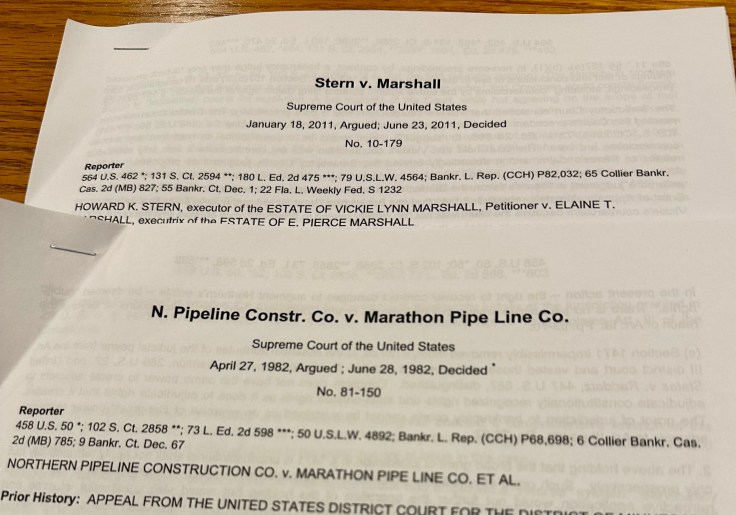
Two years later (forty four years ago), the U.S. Supreme Court issues its Northern Pipeline Construction Co. v. Marathon Pipe Line Co., 458 U.S. 50, opinions on June 28, 1982.
Twenty nine years later (15 years ago), the U.S. Supreme Court issues its Stern v. Marshall, 564 U.S. 462, opinions on June 23, 2011.
My legal career begins when the Bankruptcy Code was still a baby—not even a toddler yet. By the time of the Northern Pipeline ruling, I already have considerable experience in practicing bankruptcy law. And by the time of the Stern v. Marshall ruling, I am a seasoned bankruptcy professional.
And so, I can attest to the trauma and confusion that the U.S. Supreme Court created within the entire bankruptcy system by both the Northern Pipeline and Stern rulings.
When Northern Pipeline came down, I remember older bankruptcy professionals wondering whether the Bankruptcy Code was a valid law in any respect:
- would the next “shoe to drop” from the U.S. Supreme Court, they wondered, be an expansion of the four-justice Northern Pipeline opinion that would have gutted the entire grant of jurisdiction to bankruptcy courts as unconstitutional?
In response to Northern Pipeline, Congress creates the “core” proceeding concept for bankruptcy court jurisdiction in 28 U.S.C. § 157. And then . . . time goes by.
A couple decades after Northern Pipeline, everyone is breathing easier. It appears that the Northern Pipeline crisis has passed:
- that the U.S. Supreme Court shot its wad, in Northern Pipeline, on attacking bankruptcy court jurisdiction; and
- that the U.S. Supreme Court, by its inaction since Northern Pipeline, is signaling that all is well on the bankruptcy jurisdiction front.
But then, June of 2011 rolls around, and the U.S. Supreme Court drops it’s next bankruptcy court jurisdiction bomb. In Stern v. Marshall, the U.S. Supreme Court:
- declares unconstitutional that part of 28 U.S.C. § 157 granting to bankruptcy courts jurisdiction over state law counterclaims arising in a proof of claim objection process—even when that counterclaim is compulsory under federal law.
The Stern v. Marshall five-justice majority opinion raises to the constitutional forefront, for bankruptcy court jurisdiction, such ideas as:
- “the stuff of the traditional actions at common law tried by the courts at Westminster in 1789”; and
- the “Public Rights Doctrine.”
I remember thinking, back in 2011 when Stern came down (as a bankruptcy attorney with three decades of experience in practicing bankruptcy law):
- “What the heck?!”
- “That makes no sense!”
- “Do the Supreme Court justices actually despise bankruptcy this much?!”
The reality is that the U.S. Supreme Court created a mess—in both Northern Pipeline and Stern. And the Supreme Court has continued to do so in many of its other bankruptcy opinions since enactment of the Bankruptcy Code.
So, I’ve long held the view that the U.S. Supreme Court, whenever it rules on a major bankruptcy issue, screws up our bankruptcy world. And I’ve never wavered in that view!
Series of Five Articles
In recognition (but not in honor) of the fifteen years anniversary of Stern v. Marshall and the forty four years anniversary of Northern Pipeline (both published in the month of June), I will be publishing (on each of the Tuesdays in June) five articles on those two cases.
This article is the first of the five articles and serves as an introduction to the series (Part 1). The four articles that follow deal with:
- “the stuff . . . tried by the courts at Westminster in 1789”—what the heck is this?! (Part 2);
- the Northern Pipeline plurality and Stern majority opinions reviewed—run amok (Part 3);
- Northern Pipeline’s three-justice dissent—too bad it didn’t prevail (Part 4); and
- Stern’s four-justice dissent—too bad it didn’t prevail (Part 5).
Conclusion
This is fascinating stuff (to me, at least). I hope you enjoy the series.
** If you find this article of value, please feel free to share. If you’d like to discuss, let me know.


Leave a Reply