By: Donald L Swanson
Will the U.S. Supreme Court consider the interests of Debtor’s creditors and bankruptcy estate in deciding whether Debtor’s pursuit of a lawsuit is barred by judicial estoppel?
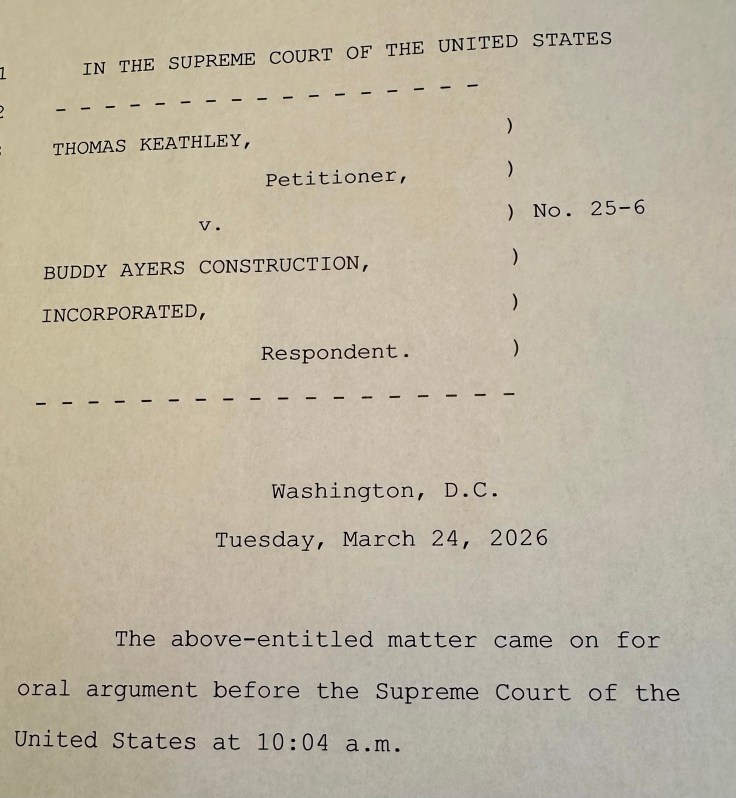
That’s an issue in Keathley v. Buddy Ayers Construction, Inc., Case No. 25-6 at the U.S. Supreme Court, in which oral arguments occurred on March 24, 2026. Here is a link to the oral argument transcript.
Background
Chapter 13 Debtor obtains a confirmed plan without disclosing the existence of a personal injury claim against Third Party.
After confirmation and during the term of the plan, debtor sues Third Party in federal district court to recover damages for the personal injury claim. Third Party moves to dismiss the personal injury lawsuit on judicial estoppel grounds.
Without any consideration of the interests of creditors in the pending bankruptcy—none whatsoever—the federal district court dismisses the lawsuit on judicial estoppel grounds. And on appeal, the Fifth Circuit Court of Appeals affirms.
Question Presented
On further appeal, the U.S. Supreme Court grants certiorari on this question:
- “Whether the doctrine of judicial estoppel can be invoked to bar a plaintiff who fails to disclose a civil claim in bankruptcy filings from pursuing that claim.”
Circuit Split—Both Sides are Wrong!
Regarding that question, the Petition cites this split of authority:
- one side of the split requires a showing of “a subjective intent to mislead” the bankruptcy court before judicial estoppel can bar pursuit of a claim; but
- the other side says that judicial estoppel is always warranted when a debtor fails to disclose a claim in bankruptcy, irrespective of whether the debtor had a subjective intent to mislead.
Amici briefs argue that both sides of the split are wrong because both sides:
- focus exclusively on the interests of Debtor/plaintiff and of the defendant in the lawsuit;
- fail to even consider—let alone address—the interests of Debtor’s creditors and bankruptcy estate; and
- give no thought, whatever, to whether the the bankruptcy court might fashion a remedy that protects the interests of Debtor’s creditors and bankruptcy estate.
From my perspective, the Amici have it right . . . both sides of the circuit split are wrong for failing to consider bankruptcy estate and creditor interests.
So, it’s with great curiosity (and a little unease in expecting the worst) that I read through the transcript of the Keathley v. Buddy Ayers oral arguments—to see if the justices are picking up on what the amici briefs are saying.
And I’m encouraged. What follows are representative excerpt of comments from various justices that provide a basis, I believe, for optimism and hope.
Transcript Excerpts
JUSTICE SOTOMAYOR:
- in a situation like this one, where the bankruptcy is still ongoing because, logically and otherwise, it should be the bankruptcy court that decides whether to impose a penalty because doing away with the personal injury suit deprives the creditors of a potential source of income for the bankruptcy [Tr. at 14];
- In an ongoing bankruptcy, that’s a draconian effect on the creditors that the second court would be imposing [id.];
- there’s no unfair detriment to the man who hit your client with a truck because he wasn’t involved in the bankruptcy, and the unfair advantage was wiped away once the disclosure was made in the bankruptcy court [Tr. at 15]; and
- There’s been no final determination that the bankruptcy court was misled in a way that caused detriment to the bankruptcy process, to its creditors, or to anyone [id.].
JUSTICE JACKSON:
- I’m thinking that maybe judicial estoppel is sort of a poor fit for this context because, even if there is an intentional omission, however we define that, the bankruptcy court has many, many tools, . . . to solve that problem when it comes to its attention, and to prevent the estate from getting this additional asset seems to harm the creditors in ways that I don’t think are consistent with the way we understand bankruptcy [Tr. at 25-26];
- Do you know if there’s ever a world . . . after the bankruptcy closes that this information comes to the bankruptcy court’s attention, is there nothing that could be done at that point . . . [Tr. at 36-37]; and
- MR. GARRE: It can be reopened. JUSTICE JACKSON: So there’s always an opportunity to take advantage? MR. GARRE: Right [Tr. at 37].
CHIEF JUSTICE ROBERTS:
- it’s not really just relitigation. It’s a new person jumping on to the scene. . . . in terms of the courts’ integrity, it does seem a little much that the one person who’s getting off is the one whose truck hit the other guy, right? [Tr. at 58]; and
- it’s a lot easier to explain why that’s a bad result than simply the idea that, oh, there was something else that went on that the court didn’t know about and now you’re going to change the natural sense of the propriety of the result by saying the one person who we know inflicted harm, according to the allegations, of course, gets off scot-free [Tr. at 58-59].
JUSTICE BARRETT:
- Am I correct that the bankruptcy court declined to sanction? MR. JAY: No party asked for sanctions, Your Honor [Tr. at 64];
- It’s my understanding the bankruptcy court knew about this because he ultimately did go back to the bankruptcy court and make the court aware. Am I right about that? MR. JAY: There’s an amended schedule that . . . doesn’t disclose the amounts but states that there is a claim [Tr. at 64-65]; and
- in this context, why wouldn’t we expect the bankruptcy court to be the one to police this? [Tr. at 65].
JUSTICE GORSUCH:
- if judicial estoppel is about protecting the integrity of the courts, I get the concern on the one side that there’s perhaps a misrepresentation to bankruptcy court [Tr. at 66];
- But the courts also have a duty and they’re open to claims of personal injury. And to give your client a windfall would also seem to have some impact . . . on the integrity of the judicial process and its accessibility. No? [Tr. at 67]; and
- if we’re concerned about the integrity of the judicial process, why isn’t one consideration that your client would just get a plain old windfall? [Id.].
Conclusion
After reading the oral arguments transcript in Keathley v. Buddy Ayers, I’m hopeful that the U.S. Supreme Court will reject both sides of the circuit split and focus, somehow and instead, on including the interests of the bankruptcy estate and its creditors in the judicial estoppel analysis, as recommended in amici briefs.
** If you find this article of value, please feel free to share. If you’d like to discuss, let me know.
 MEDIATBANKRY
Leave a comment