By: Donald L Swanson
Even though a bankruptcy petition is improperly filed, the bankruptcy court still has subject matter jurisdiction over the case—but must dismiss it.
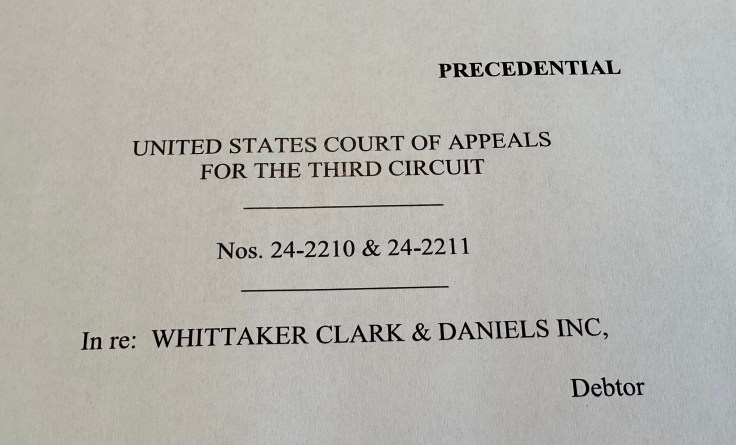
That’s what the U.S. Third Circuit Court of Appeals declares in In re Whittaker Clark & Daniels, Inc., Case Nos. 24-2210 & 24-2211 (3rd Cir., decided September 10, 2025).##
What follows is a summary of the Third Circuit’s analysis thereon.
A Properly Filed Bankruptcy Petition Is Not a Jurisdictional Prerequisite.
The Third Circuit’s Whittaker opinion identifies this “predicate question”:
- does the propriety of a bankruptcy petition filing affect the bankruptcy court’s subject matter jurisdiction? or
- is the propriety of a bankruptcy petition filing, instead, a non-jurisdictional (but nonetheless integral) component of a bankruptcy case?”
And the Third Circuit’s answers: “We conclude it is the latter.”
Put another way, an improperly filed bankruptcy petition:
- “does not strip bankruptcy courts of subject matter jurisdiction,” but
- instead, “constitutes ‘cause’” for dismissing the bankruptcy case, under § 1112(b)(1).
Cause
The Bankruptcy Code provides for dismissal of a Chapter 11 bankruptcy case, after notice and a hearing, “for cause” (§ 1112(b)(1)).
“Cause” typically includes things like:
- “gross mismanagement of the estate”;
- “failure to comply with an order of the court”; and
- “material default by the debtor with respect to a confirmed plan.”
“Cause” also includes occasions when a debtor does not have the proper authority to commence the bankruptcy proceeding. In such occasions, the U.S. Supreme Court has declared, the bankruptcy court must dismiss the petition.[Fn. 1]
Jurisdiction
The U.S. Supreme Court has described the necessity of proper authority to file a bankruptcy petition as a limitation on the bankruptcy court’s “jurisdiction,” like this:
- “nowhere is there any indication that Congress bestowed on the bankruptcy court jurisdiction to determine that those who in fact do not have the authority to speak for the corporation . . . should be empowered to file a petition on behalf of the corporation.”[Fn. 2]
“Jurisdiction,” however, “is a word of many, too many, meanings.”[Fn. 3] And some courts have taken the Supreme Court’s mention of “jurisdiction” in such context to mean a limitation on a bankruptcy court’s subject matter jurisdiction. However:
- under such an understanding, the absence of a properly filed petition would extinguish a court’s power to hear a case; but
- in recognition of the “unique potential” of a jurisdictional limitation “to disrupt the orderly course of litigation,” more recent Supreme Court cases exercise greater care before hanging the “jurisdictional label” on a statutory provision.[Fn. 4]
–Exacting Standard
Today, the standard for concluding that a statute limits a federal courts’ subject matter jurisdiction is an exacting one:
- while Congress need not employ any specific formulation or “incant magic words,” the traditional tools of statutory construction must plainly show that Congress imbued a procedural bar with jurisdictional consequences; and
- anything short of a “clear indication” that jurisdictional consequences were intended will not do.[Fn. 5]
The statutes granting federal courts jurisdiction over bankruptcy cases do not attach jurisdictional significance to the propriety of a debtor’s petition:
- the governing provision, 28 U.S.C. § 1334(a), provides only that “the district courts shall have original and exclusive jurisdiction of all cases under title 11”; and
- a related provision, 28 U.S.C. § 157(a)&(b)(1), provides:
- “district court[s] may provide that any or all cases under title 11 . . . shall be referred to the bankruptcy judges for the district”; who
- “may hear and determine all cases under title 11 . . . and may enter appropriate orders and judgments.”
Such statutes:
- establish the jurisdictional grant for district and bankruptcy courts over bankruptcy cases; and
- do not condition that grant on a properly filed petition.
–§ 301(a)
Further, 11 U.S.C. § 301(a):
- deals with bankruptcy petitions; and
- provides only that a voluntary bankruptcy “is commenced by the filing with the bankruptcy court of a petition under such chapter by an entity that may be a debtor under such chapter.”
Such statute focuses on the commencement of a bankruptcy case by a debtor, not on the power of the court to decide. Simply put:
- § 301(a) does not speak in jurisdictional terms[fn. 6]; and
- we will not lightly apply the jurisdictional label to a provision absent a “clear statement” to the contrary.[Fn. 7]
Conclusion
Good to know.
—————————
## = This is the second of five articles on the In re Whittaker opinion.
Footnote 1. Price v. Gurney, 324 U.S. 100, 106 (1945). This opinion is decided under the Federal Bankruptcy Act that preceded our Bankruptcy Code of today.
Footnote 2. Id., at 107 (emphasis added).
Footnote 3. Steel Co. v. Citizens for Better Environment, 523 U.S. 83, 90 (1998).
Footnote 4. Wilkins v. United States, 598 U.S. 152, 157-58 (2023).
Footnote 5. Boelcher, P.C. v. Commissioner of Internal Revenue, 596 U.S. 199, 203 (2022).
Footnote 6. Zipes v. Trans World Airlines, Inc., 455 U.S. 385, 394 (1982).
Footnote 7. Wilkins v. United States, 598 U.S. 152, 158 (2023).
** If you find this article of value, please feel free to share. If you’d like to discuss, let me know.
 MEDIATBANKRY
Leave a comment