By: Donald L Swanson
Here’s a curious thing:
- an advisory opinion from a U.S. Circuit Court of Appeals on an issue for which there is no controversy and that is mostly academic.
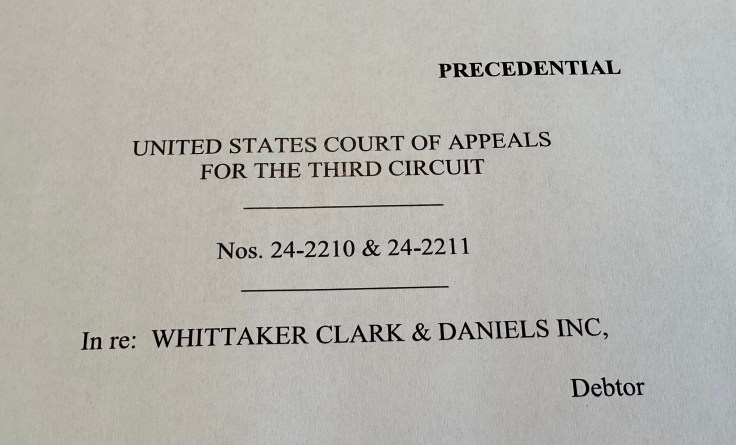
That’s exactly what we have in In re Whittaker Clark & Daniels, Inc., Case Nos. 24-2210 & 24-2211 (3rd Cir., decided September 10, 2025)(see first concurring opinion).##
No Controversy
The Whittaker case involves a receiver appointed by a South Carolina state court over a New Jersey corporation.
When the corporation files bankruptcy and the legal effects of the receivership become contested, a question is whether the Bankruptcy Court should apply South Carolina law or New Jersey law to resolve the contested issues.
The Third Circuit’s majority opinion in Whittaker declares that the question is resolved by the parties, like this:
- “But which state’s law governs?”
- “Fortunately, the parties make answering this question easy”; and
- “They agree that New Jersey law governs” (at 17-18).
So, there is no choice-of-law controversy for the Third Circuit to resolve.
Advisory Opinion
Undeterred by the absence of a controversy, the first concurring opinion declares an intention to provide an advisory opinion on the very question that the parties resolved:
- “I write separately, however, to address which choice-of-law rules govern in bankruptcy—an issue that both looms in the background of this case and that has divided courts for decades”;
- “confusion about how to resolve this conflict-of-laws question in bankruptcy cases will persist in our Circuit absent guidance from our Court”;
- “I write here with an eye towards that eventual resolution”; and
- “As it turns out, the answer lies in established doctrine” (at 1-2).
And this first concurring opinion spans 38 pages.
–No “Guidance”
Unfortunately, the advisory opinion offers no “guidance from our Court” at all, because the author of the majority opinion also authors a 15-page second concurring opinion to disagree with the analysis and conclusions of the first concurring opinion.
–Second Concurring Opinion
Here’s how the second concurring opinion tees up the disagreement:
- “Our concurring colleague has staked out her position that Klaxon always applies in bankruptcy, no exceptions”; and
- “Because I am uncomfortable with that view, I instead take the opportunity to make some nonbinding observations about Erie and choice of law” (at 2).
An Academic Issue
Also curious is this reality: the question of whether state or federal law should govern a choice of law issue in bankruptcy is largely an academic question, for which there is no consensus:
- “the question whether Klaxon applies in bankruptcy has spawned interesting academic debate”; and
- “Answers span the spectrum” (second concurring opinion at 1).
Conclusion
It’s curious indeed: an advisory opinion on a largely-academic issue that the parties already stipulated away.
Surely there is an interesting back story! Would love to know what it might be.
———————
## = This is the fifth of five articles on the In re Whittaker opinion.
** If you find this article of value, please feel free to share. If you’d like to discuss, let me know.
 MEDIATBANKRY
Leave a comment