By: Donald L Swanson
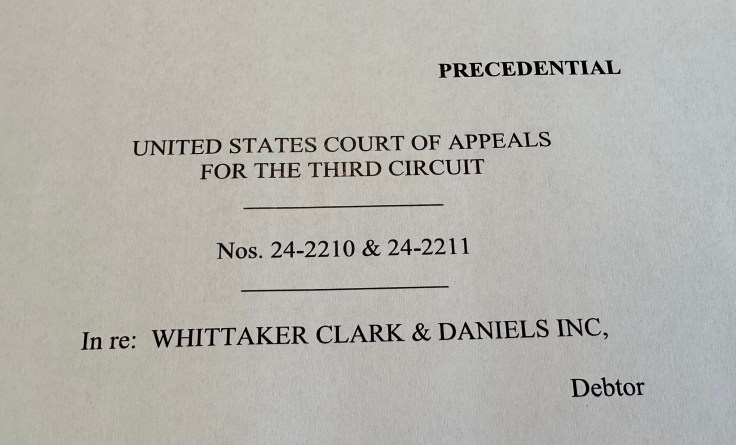
It’s not every day that the author of a Circuit Court opinion also authors a concurring opinion. But that’s exactly what happens here: In re Whittaker Clark & Daniels, Inc., Case Nos. 24-2210 & 24-2211 (3rd Cir., decided September 10, 2025).##
Overview
The issue in the concurring opinion deals with this question: whether federal courts sitting in bankruptcy jurisdiction can ever create federal common law choice-of-law rules.
That issue is not analyzed in the majority opinion because:
- the majority opinion asks — where a South Carolina state court has putatively exercised authority over the assets of a New Jersey corporation, in the New Jersey corporation’s subsequent bankruptcy do we apply New Jersey law or South Carolina law?
- the majority opinion answers — fortunately, the parties make answering this question easy, because they agree that New Jersey law governs.
Two Concurring Opinions
Despite that issue being resolved-by-the-parties, the Third Circuit’s ruling includes two separate concurring opinions on that issue, asserting positions that differ slightly:
- the first says that bankruptcy courts can never create special choice-of-law rules; but
- the second (by the author of the majority opinion) disagrees—saying that bankruptcy courts can do so in rare circumstances.
Notably, the majority opinion in Whittaker covers 29 pages, while the two concurring opinions cover 53 pages (38 pages for the first and 15 pages for the second)—on an issue the parties resolved by stipulation.
What follows is a summary of the second concurring opinion, which identifies and responds to the arguments of the first concurring opinion.
Erie Doctrine
The Erie doctrine (established by Erie R.R. Co. v. Tompkins, 304 U.S. 64 (1938)) stands for three basic propositions.
First, there is no federal general common law.
- neither Congress nor the federal courts can, under the guise of formulating rules of decision for federal courts, fashion rules that are unsupported by a grant of federal authority in Article I or some other section of the Constitution; and
- when the Constitution does authorize Congress or courts to do so, Erie has no application, and federal law displaces contrary state law through the Supremacy Clause.
Second, without a federal statute or constitutionally authorized federal common law rule, the Rules of Decision Act, 28 U.S.C. § 1652, commands federal courts to apply the rules of decision of their forum states.
Third, when a Federal Rule (e.g., the Federal Rules of Civil Procedure) conflicts with state law, then the Rules Enabling Act, 28 U.S.C. § 2072, not the Rules of Decision Act, determines which law applies.
Federal Common Law After Erie
Erie ended the general federal common law, but the Supreme Court has been unequivocal in recognizing that the Erie doctrine does not entirely displace federal common law.
Justice Brandeis acknowledged, in a decision released on the same day as Erie, that federal courts may still formulate special federal common law on issues of uniquely federal interest. Here are examples:
- interstate water apportionment is a question of “federal common law” upon which neither the statutes nor the decisions of either state can be conclusive;
- federal courts may still generate common law rules when the policy of the law is so dominated by the sweep of federal statutes and doctrines developed under them that the legal relations they affect must be deemed governed by federal law; and
- it can sometimes be inferred from congressional or constitutional intent that the federal courts should supply the necessary rule of decision by pronouncing common law to fill the interstices of a pervasively federal substantive framework.
To be sure, the cases in which judicial creation of a special federal rule would be justified are “few and restricted.” But when a significant conflict between some federal policy or interest and the use of state law is shown, federal courts have power to create special federal common law, including choice-of-law rules.
To recap:
- when Congress or federal courts validly promulgate some federal rule of decision under a source of constitutional authority, then federal law displaces contrary state law;
- absent that kind of federal law, then the Rules of Decision Act applies, which commands federal courts to apply state rules of decision; and
- even after Erie, federal courts retain the power to promulgate special federal common law rules when a strong federal interest requires such rules—but such cases are rare.
What Choice-of-Law Rules Govern in Bankruptcy?
Klaxon Co. v. Stentor Elec. Mfg. Co., 313 U.S. 487 (1941), establishes that, when a federal court sits in diversity, it must use the choice-of-law rules of the state in which it sits.
This leaves our main questions:
- Does Klaxon apply in federal bankruptcy litigation, and
- If so, may federal courts ever use special federal common law choice-of-law rules instead?
On these questions, the circuits are split:
- the Ninth Circuit limits Klaxon to diversity cases, and thus federal courts must apply federal choice-of-law principles in bankruptcy cases;
- the Fifth Circuit at one time took a view similar to the Ninth Circuit’s—but it seems more recently to have second-guessed whether it conclusively settled the question (“it is an open question in this circuit as to whether courts exercising bankruptcy jurisdiction should apply forum or federal choice-of-law rules”);
- the Eighth Circuit has arguably held that Klaxon applies categorically in federal bankruptcy cases without exception—”I say ‘arguably’” because that decision passes on the issue in a single conclusory sentence (“bankruptcy court applies the choice of law rules of the state in which it sits”) with no further analysis; and
- the Second and Fourth Circuits have held that Klaxon applies in federal bankruptcy proceedings unless a strong federal interest justifies creating federal choice-of-law rules as a matter of federal common law.
The second concurring opinion declares, “I believe that the Second and Fourth Circuits have it right.”
–Erie and Klaxon Apply Outside General Diversity Jurisdiction.
I believe, adds the second concurring opinion, it is wrong to conclude that Erie applies only in federal diversity cases: Erie applies to any questions which arise in federal court but whose determination is not a matter of federal law. Given the three-propositions framework described above, this makes sense: without on-point federal law, the Rules of Decision Act governs, and that statute does not turn on the basis of federal jurisdiction.
If we accept that Erie applies whatever the basis of federal jurisdiction, then it does not take much more analysis to conclude that the same is true for Klaxon. As the Fourth Circuit explains: it would be anomalous to have the same property interest governed by the laws of one state in federal diversity proceedings and by the laws of another state where a federal court is sitting in bankruptcy.
–Federal Courts May Apply Federal Common Law Choice-of-Law Rules in Bankruptcy, When Strong Federal Interests Warrant Doing So.
Klaxon applies in bankruptcy proceedings when addressing state-law questions: that much we agree on.
The sole remaining wrinkle is whether federal courts sitting in bankruptcy must always apply the forum state’s choice-of-law rules when the underlying issue is governed by state law:
- that is where I (second concurring opinion) part with our (first) concurring colleague—who contends that federal courts sitting in bankruptcy jurisdiction can never create federal common law choice-of-law rules, based upon some combination of five reasons.
Here are such five reasons from the first concurring opinion and a response to each in the second concurring opinion.
First, the Bankruptcy Code generally absorbs state laws to define the parties’ property interests, and so it follows that state choice-of-law rules must also apply.
RESPONSE: It is true that that federal courts sitting in bankruptcy regularly look to governing non-bankruptcy law (often state law) to determine parties’ rights and obligations when the Bankruptcy Code does not supply a federal rule.
That federal courts confronted with state-law questions should use state choice-of-law rules to avoid jurisdiction shopping is not an interest unique to bankruptcy. Yet even federal courts sitting in diversity jurisdiction may theoretically formulate special federal common law to protect important federal interests, and when courts do so, neither Erie nor Klaxon prevents them from using those rules instead of state law.
While bankruptcy ordinarily absorbs state substantive law so that federal courts in bankruptcy will rarely have a good reason to create federal choice-of-law rules, that does not support the broader argument that federal courts can never create special choice-of-law rules in bankruptcy.
Second, the Bankruptcy Code is intended to facilitate the orderly resolution of competing creditors’ claims without significantly affecting their underlying entitlements, and federal choice-of-law rules, if allowed, could change the outcome.
RESPONSE: This argument at most suggests that the circumstances are rare under which federal courts could justifiably create federal common law that affects the parties’ underlying rights and entitlements.
But rare is not never:
- there may be times when the purpose of the Bankruptcy Code may be best served by special federal choice-of-law rules; and
- it may be unlikely that such a circumstance arises, but it is overconfident and unnecessary to disclaim the possibility once and for all.
Third, federal courts have limited power to make federal common law.
RESPONSE: It is true that the creation of federal common law is appropriate only when there is a significant conflict between some federal policy or interest and the use of state law and that such a conflict is a precondition for federal common law-making.
But such truth does not support the conclusion that federal courts sitting in bankruptcy jurisdiction can never create federal common law choice-of-law rules
The first concurring opinion acknowledges that federal courts can create federal common law rules when there is a sufficiently strong federal interest threatened by state law, and the never-in-bankruptcy argument mistakes rareness for impossibility.
The first concurring opinion also appeals at times to separation-of-powers principles and cautions against leaving courts “to divine untold rules from some brooding cloud of federal interests.” But this misses the point:
- no one has suggested that federal courts can or should exercise freewheeling lawmaking power or identify federal interests without congressional guidance; but
- Congress may express federal interests through statute—for example, the Bankruptcy Code; and
- courts may, in rare circumstances, create federal common law to give effect to those congressionally endorsed interests, particularly when applying state law would undermine Congress’s objectives.
Fourth, if there were some reason to create a federal rule of decision in bankruptcy, federal courts would be better off creating a rule of decision rather than a choice-of-law rule.
RESPONSE: The first concurring opinion claims that it is hard to imagine a case involving a federal interest strong enough to justify federal common law but not strong enough to justify a substantive rule of decision rather than a choice-of-law rule.
Under that view, for the Second and Fourth Circuits’ approach to be correct, “a federal interest has to fall into the goldilocks zone”:
- “Maybe so”; but
- “this also is not an argument against the power of federal courts to create federal choice-of-law rules in bankruptcy”;
- “It is an argument for the claim that the circumstances when courts would need to do so are ‘few and restricted’”; and
- “Judicial humility cautions against making the sweeping claim, in the absence of a case or controversy before us, that no such interest can exist just because one has not presented itself.”
Fifth, any federal interest strong enough to generate a federal choice-of-law rule would be explicit in the Bankruptcy Code itself, and the absence of choice-of-law rules in the Bankruptcy Code means there is never any such interest.
RESPONSE: The first four arguments support only that state choice-of-law rules will almost always apply.
The fifth argument, however, “is where we part,” because the U.S. Supreme Court recognizes that sufficiently strong federal interests may warrant creating special federal common law.
The first concurring opinion (i.e., that federal courts can never develop choice-of-law rules in bankruptcy) is based on this:
- the Bankruptcy Code does not contain choice-of-law rules; and
- that means there is no such interest.
The premise is faulty because it would apply with equal strength to the power of federal courts to create substantive common law rules in bankruptcy. Yet, in the view of the first concurring opinion, a sufficiently strong federal interest could warrant a federal substantive rule—but
- “never a choice-of-law rule.”
How can that be?
- If federal courts can sometimes formulate a rule of decision whose content absorbs the law of the defendant’s state of incorporation, “then I do not understand why” they could not also formulate a choice-of-law rule that selects the law of the defendant’s state of incorporation.
Stepping Back
It is worth stepping back to get a clear view of the argument in the first concurring opinion:
- Erie’s constitutional rule does not prohibit federal courts from developing special federal common law when the Constitution or federal statute authorizes them to do so; and
- federal courts can properly exercise their limited common lawmaking authority to create a rule of decision that always incorporates the contents of state substantive law.
At its core, the argument is merely that a case cannot be imagined in which a federal court would need to create a federal choice-of-law rule in bankruptcy; but
- that is not an argument that federal courts lack the authority to make choice-of-law rules in bankruptcy.
Put another way, we should not succumb to the “beguiling tendency” to make conflict-of-law problems more complicated than they are. The proper rule is, simply, this:
- absent an overwhelming federal policy that requires us to formulate a choice of law rule as a matter of independent federal judgment, we adopt the choice of law rule of the forum state.
Conclusion
Good to know.
——————-
## = This is the fourth of five articles on the In re Whittaker opinion.
** If you find this article of value, please feel free to share. If you’d like to discuss, let me know.
 MEDIATBANKRY
Leave a comment