By: Donald L Swanson
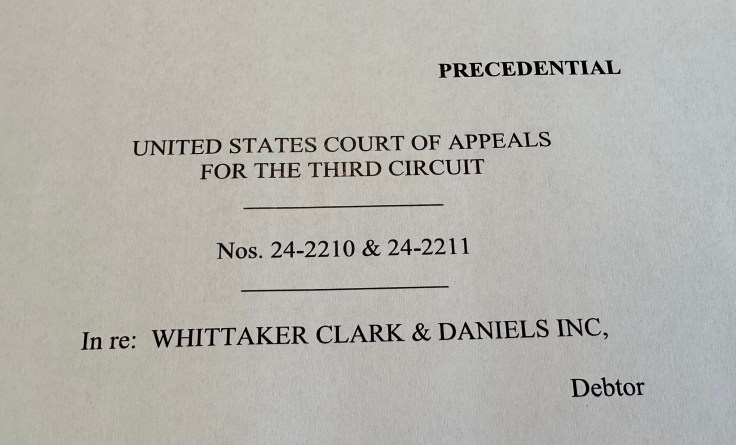
The question of who owns “product line” successor liability claims is addressed and resolved in In re Whittaker Clark & Daniels, Inc., Case Nos. 24-2210 & 24-2211 (3rd Cir., decided September 10, 2025).##
Facts
The Whittaker Debtor processes, manufactures, and distributes industrial chemicals and minerals, including talc.
Through a series of corporate transactions, Debtor sells substantially all its operating assets to the Whittaker Purchaser. As part of the transaction:
- Debtor ceases to operate and is left as a shell company to manage asbestos liability from Debtor’s operating businesses; and
- Debtor indemnifies the Whittaker Purchaser for any liabilities the Purchaser incurs from asbestos-related tort claims.
Before Debtor files bankruptcy, plaintiffs across the country file 2,700 suits against Debtor for asbestos related torts.
One of those suits is in the South Carolina Court of Common Pleas, based on Plaintiff’s diagnosis of mesothelioma from asbestos-contaminated talc produced by the Whittaker Debtor. In that suit, a jury grants Plaintiff a $29 million verdict against Debtor.
So, the Whittaker Debtor files bankruptcy, and the U.S. Trustee appoints an Official Committee of Talc Claimants.
In the Bankruptcy, Debtor files an adversary proceeding against the Whittaker Purchaser and hundreds of individual talc plaintiffs—seeking a declaratory judgment that the Successor Liability Claims against Whittaker Purchaser (premised on a “product line” theory of liability) are property of Debtor’s bankruptcy estate and do not belong to the individual claimants. And the Whittaker Talc Committee intervenes.
In such adversary proceeding, the Bankruptcy Court grants summary judgment to Debtor—agreeing that:
- the “product line” Successor Liability Claims are property of Debtor’s bankruptcy estate; and
- § 544(a)(1) provides an additional basis for drawing those claims into the bankruptcy estate.
The Question & The Answer
On appeal, the Third Circuit Court of Appeals identifies the following question and answer.
Question: Do Debtor’s assets include the “product line” Successor Liability Claims for asbestos liability?
Answer: “We conclude they do.”
What follows is a summary of the Third Circuit’s rationale.
Legal Standards
At the outset of a bankruptcy, the bankruptcy estate includes “all legal or equitable interests of the debtor in property,” including causes of action, “wherever located and by whomever held” (§ 541(a)(1)).
This feature of bankruptcy law can have significant repercussions, because once a cause of action becomes the estate’s property, the Bankruptcy Code gives the trustee/DIP, and only the trustee/DIP, the statutory authority to pursue it.
In order for a claim putatively held by a creditor to belong to the bankruptcy estate, two conditions must be met:
- it must have existed at the outset of the bankruptcy; and
- it must be a “general” claim, meaning one with no particularized injury arising from it.
Whether a claim is “general” to all creditors or “personal” to a specific creditor calls for an examination of the nature of the cause of action itself. In doing so, we focus not on the nature of the injury, but on the “theory of liability”:
- “general” claims are ones based on facts generally available to any creditor and for which recovery would serve to increase the pool of assets available to all creditors; and
- this is contrasted with “personal” claims, which are specific to the creditor and in which other creditors generally have no interest—
- a claim is “personal” when the creditor’s injury can be directly traced to wrongful conduct committed by the defendant, whether that be the debtor or a third party.
So, whether a claim is in or out of the bankruptcy estate determines who can pursue (and recover on) that claim—a difference, as this case demonstrates, with significant consequences.
Precedent—In re Emoral, 740 F.3d 875 (3d Cir. 2014)
In Emoral, the bankruptcy debtor manufactured a chemical used in food flavoring, later found to cause lung ailments. A Buyer bought some of debtor’s assets out of bankruptcy and assumed some of debtor’s liabilities.
Later, a group of plaintiffs sued Buyer for injuries they suffered from Emoral’s products—on the theory that Buyer was the “mere continuation” of Emoral and thus liable for plaintiffs’ personal injury and product liability claims, as Emoral’s successor.
The Third Circuit held the successor liability claims against Buyer were “general” claims and belonged to Emoral’s bankruptcy estate, rather than to individual creditors.
Because plaintiffs had not alleged “any direct injury” caused to them by Buyer, plaintiffs failed to demonstrate how any of the factual allegations were unique to them as compared to other creditors of Emoral.
While the Emoral plaintiffs focused on the individualized nature of their personal injury claims against Emoral, the same could not be said about their claims against Buyer:
- their only theory of liability on such claims depends on Buyer’s status as Emoral’s successor—not on Buyer’s relationship with or conduct toward plaintiffs.
Whittaker Mirrors Emoral
The Whittaker case mirrors Emoral, which sounds the death knell for the Whittaker Talc Committee’s arguments.
Start from the beginning:
- the Whittaker Talc Committee’s theory of liability against Debtor’s Purchaser depends exclusively on the relationship of Debtor’s Purchaser to Debtor, not on any interaction of Debtor’s Purchaser with individual claimants;
- the Whittaker Talc Committee attempts to hold Debtor’s Purchaser liable under a “product line” tort theory, which:
- imposes strict liability (for injuries from defects of a product line) on a purchaser of debtor’s manufacturing assets, who continues the same manufacturing operation; and
- while the “product line” theory of liability is distinct from the “mere continuation” theory advanced in Emoral:
- the Whittaker Talc Committee (just as the plaintiffs in Emoral) seeks to impose Debtor’s liability onto Debtor’s Purchaser, solely due to the status as Debtor’s successor; and
- not because of any particularized injury that can be “directly traced” to the conduct of Debtor’s Purchaser.
So, the “product line” Successor Liability Claims against Debtor’s Purchaser belong to Debtor’s estate, meaning such claims are for the Debtor to pursue or settle, not for the Whittaker Talc Committee or its constituents.
Whittaker Committee Challenges
The Whittaker Talc Committee challenges the logic described above on two fronts.
First, the Whittaker Talc Committee points to this legal standard: the claim must have existed at the outset of the bankruptcy.
The Committee’s challenge is that Debtor did not have an independent right under state law, before filing bankruptcy, to bring any of the Successor Liability Claims. The Committee points to a footnote in a Third Circuit opinion and seeks to add this requirement:
- that a debtor must have, before filing bankruptcy, a state cause of action to assert in order for a claim to be property of the estate.
The Third Circuit rejects such challenge:
- “this argument divines too much from too little”; and
- “while the ability to assert the claim on his own behalf under state law is enough to become property of the estate, it is not necessary.”
Second, the Whittaker Talc Committee argues that the “product line” Successor Liability Claims are not “general” because:
- the product line theory of liability against Whittaker Purchaser involves “specific claims exclusively belonging to victims injured by defective products” that “arise from harms unique to those victims . . . based on conduct of the successor entity”; and
- such claims do not inure to the benefit of all creditors because they are only available to “personal-injury and environmental tort creditors; they do not include, for example, the Debtors’ various commercial and contract creditors.”
The Third Circuit rejects such challenge:
- “this argument may have intuitive appeal,” but “our precedent has already rejected it”;
- when assessing whether a claim is “general” or “personal,” we focus not on the nature of the injury, but on the “theory of liability”;
- the “product line” theory depends entirely on the successor’s relationship with the manufacturer, because it is the successor’s acquisition and continuation of the manufacturer’s operation that creates successor liability to individual claimants; and
- the facts on which “product line” liability depend—the successor’s relationship with the manufacturer—do not implicate a claim that is “specific to the creditor.”
In Whittaker, the talc claimants’ injuries trace only to the exposure to asbestos-contaminated products manufactured by Debtor at a time before the Whittaker Purchaser was even in the picture:
- this obviates their being “directly traced” to the Whittaker Purchaser; and
- such claims are quintessentially “general.”
Conclusion
Good to know.
—————
## = This is the third of five articles on the In re Whittaker opinion.
** If you find this article of value, please feel free to share. If you’d like to discuss, let me know.
 MEDIATBANKRY
Leave a comment