By: Donald L Swanson
A receiver is appointed for Debtor. Then Debtor’s board of directors puts Debtor into bankruptcy,
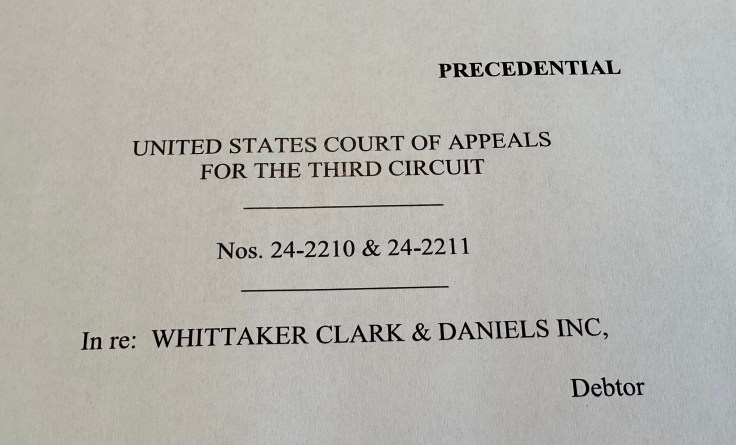
Litigation ensues, resulting in this appellate opinion from the U.S. Third Circuit Court of Appeals: In re Whittaker Clark & Daniels, Inc., Case Nos. 24-2210 & 24-2211 (3rd Cir., decided September 10, 2025).##
One of the Q & As in the Third Circuit’s opinion is this:
Question: Was Debtor’s bankruptcy petition “improperly filed”?
Answer: “We conclude” that (i) Debtor “properly filed for bankruptcy,” and (ii) the Bankruptcy Court and District Court “correctly declined to dismiss its petition.”
Here’s what happened.
Facts
Debtor is a New Jersey corporation in the business of processing, manufacturing, and distributing industrial chemicals and minerals, including talc.
Plaintiffs across the country file 2,700 suits against Debtor for asbestos-related torts.
Through a series of corporate transactions, Debtor ceases operations and is left as a shell company to manage asbestos liability from Debtor’s operating businesses.
Order Appointing Receiver
Included in those 2,700 suits is one filed in the South Carolina Court of Common Pleas, based on Plaintiff’s diagnosis of mesothelioma from asbestos-contaminated talc produced by Debtor.
In that suit, a jury awards Plaintiff a $29 million verdict against Debtor.
Days later, Plaintiff moves the South Carolina Court to place Debtor into receivership. The South Carolina Court grants Plantiff’s motion and enters an Order appointing Receiver, which Order vests Receiver “with the power and authority” to:
- “fully administer all assets” of Debtor;
- “accept service on behalf” of Debtor;
- “engage counsel on behalf” of Debtor; and
- “take any and all steps necessary to protect the interests” of Debtor, “whatever they may be.”
Debtor moves the South Carolina Court to reconsider and, at a hearing thereon, the suggestion is made that Debtor still has “authority to enter into voluntary bankruptcy.” In response, the South Carolin Court says:
- “the main factor in my signing the order so quickly is that I wanted to be sure” that Debtor “would not simply declare bankruptcy.”
[Editorial Comment: This state court judge is, apparently, unaware that Congress has exercised its authority under the U.S. Constitution to establish a bankruptcy process explicitly designed to deal with asbestos liabilities — see 11 U.S.C § 524(g)(h). Or, perhaps, the state court judge simply does not like what Congress provided?]
So, the South Carolina Court denies Debtor’s motion to reconsider.
Bankruptcy Filing & Refusals to Dismiss
Shortly thereafter, Debtor files a voluntary Chapter 11 petition in the New Jersey Bankruptcy Court, based upon a resolution passed by Debtor’s board of directors — the Board acts without gaining the approval of, or even consulting with, Receiver.
In response, Receiver moves the Bankruptcy Court to dismiss Debtor’s bankruptcy as an unauthorized petition, arguing that the Order appointing Receiver:
- “divested [Debtor’s] board of the authority to approve a bankruptcy filing on [Debtor’s] behalf“; and
- “instead gave such authority to the Receiver alone.”
The Bankruptcy Court denies Receiver’s motion to dismiss. Receiver appeals to the District Court, which affirms. Receiver then appeals to the Third Circuit Court of Appeals, which also affirms in the opinion linked above.
Debtor “Properly Filed Its Bankruptcy Petition”
The Third Circuit’s opinion declares that Debtor “properly filed its bankruptcy petition.”
Here’s why.
–New Jersey State Law
“We look to governing state law to determine the propriety of a corporation’s bankruptcy petition.” That’s because:
- the Supreme Court has long held that local law governs a corporate debtor’s authority to petition for bankruptcy; and
- because corporations are creatures of state law, it is state law which is the font of corporate directors’ powers.
But which state’s law governs?
- here, a South Carolina court has putatively exercised authority over the assets of a New Jersey corporation; and
- so, is the authority of Debtor’s board to file bankruptcy governed by New Jersey law or South Carolina law?
Fortunately, the parties make answering this question easy: they all agree, it’s New Jersey law.
–Revised Q & A
So the revised question becomes: whether, under New Jersey law, the Order appointing Receiver stripped Debtor’s board of the authority to file bankruptcy.
The answer is: “It did not,” for the following three reasons.
First: On its Face.
The Order appointing Receiver does not reach as far as Receiver insists.
Rather, the Order only gives the Receiver, (i) control of Debtor’s “assets,” and (ii) power and authority to “take any and all steps necessary to protect the interests of [Debtor] whatever they may be.”
Nowhere does the Order speak to debtor’s corporate affairs, including the board’s authority under New Jersey law to decide whether to file for bankruptcy.
Second: Ancillary Receiver Needed
But even if the language of the Order appointing Receiver had been sufficient to include authority to file bankruptcy, Debtor’s board would still hold authority over filing Debtor’s bankruptcy:
- because an ancillary receiver was not appointed in New Jersey.
State courts retain the traditional equitable authority to appoint receivers for insolvent corporations. But that authority has limits:
- under New Jersey law, comity requires that a receiver appointed in another state be acknowledged and aided in New Jersey; and
- where another state appoints a receiver, New Jersey courts will generally appoint an ancillary receiver to assure that debtor’s assets are administered in a manner that allows creditors in New Jersey and in the other state to “fare alike.”
In other words, New Jersey law allows its courts to recognize receivership orders from other states and to appoint an ancillary receiver to assist, including by enjoining the corporation and its board from taking specific actions and exercising specific powers.
The Restatement (Second) of Conflict of Laws agrees:
- “When a principal receiver of a corporation has been appointed by a court of a state other than the state of incorporation, and it is intended to dissolve the corporation . . . , an ancillary receiver should be appointed for those purposes by a court of the state of incorporation.”
One rationale for such a rule is this: only a receiver appointed by a court in the state where the corporation was incorporated can institute action to dissolve a corporation.
So, Receiver appointed by the South Carolina Court needed to move for and be granted, in New Jersey, appointment of an ancillary receiver to displace the control of Debtor’s board over Debtor’s privileges, franchises and assets.
Receiver did not do so:
- which means that Debtor’s board retains authority over those corporate decisions reserved to it by New Jersey law; and
- such decisions include whether to reorganize by filing for bankruptcy.
Third: Full Faith and Credit & Equal Sovreignty
Receiver responds by invoking one of our Nation’s oldest laws—the Full Faith and Credit statute, 28 U.S.C. § 1738.
Receiver argues that, under Full Faith and Credit obligations, “New Jersey could not ignore the Receivership Order—just as the Bankruptcy Court could not ignore it.”
This argument falters, however, on the fundamental principle of “equal sovereignty” among the states, which permits (i) a state to act upon persons and property within the limits of its own territory, and (ii) permits “different communities to live with different local standards.”
But a states’ power to exercise control over actors within its own borders has limits, such as:
- the Due Process Clause of the Fourteenth Amendment limits a state courts’ authority to determine rights of non-resident parties;
- the dormant Commerce Clause prohibits economic protectionism—i.e., regulatory measures designed to benefit in-state economic interests by burdening out-of-state competitors; and
- a state cannot regulate the internal affairs of corporations from another state.
Receiver contends that the Order of the South Carolina Court appointing Receiver “divested” authority from Debtor’s board to conduct the internal affairs of the corporation—including the authority to file bankruptcy.
Such contention, if approved, would be:
- an unprecedented exertion of a state’s power over a foreign corporation whose internal affairs are governed by the laws of a sister state; and
- a radical intrusion into the province of a co-equal sovereign.
Put another way: under our Constitution, the state of incorporation enjoys exclusive authority to govern the internal affairs of its corporations, another state may not intrude on that authority, and a constitutionally infirm judgment is not entitled to full faith and credit.
Conclusion
Good to know.
—————-
## = This is the first of five articles on the In re Whittaker opinion.
** If you find this article of value, please feel free to share. If you’d like to discuss, let me know.
 MEDIATBANKRY
Leave a comment