By: Donald L Swanson
“Were Congress to . . . intervene and expand § 524(g) beyond asbestos cases, bankruptcy would become a more suitable alternative for resolving mass tort cases. Until then, such cases will likely remain problematic under the Code in the face of creditor opposition.”
- From “Order Dismissing Bankruptcy Cases” in 3M bankruptcy (In re Aearo, et al).[Fn. 1]
Congress needs to do what the foregoing quote suggests: “intervene and expand § 524(g) beyond asbestos cases” to protect future claimants in other types of mass-tort cases.
The current mass-tort cases asserting talc claims against Johnson & Johnson and others illustrate why Congress should intervene.
Asbestos Bankruptcy History
In 2022, the Third Circuit Court of Appeals explains the history of § 524(g), in a case involving mass-tort claims against a talc supplier (Imerys), as follows.[fn. 2]
–Asbestos Issues
Imerys is among the latest in a long line of companies who turn to bankruptcy in response to the crushing liability imposed by mounting asbestos and talc personal injury claims.
Asbestos liabilities pose particular challenges for bankruptcy proceedings:
- Chapter 11 normally affects only the rights of a debtor’s current creditors and equity holders; but
- many claimants who will suffer harm from asbestos exposure will not manifest those injuries until long after debtors’ reorganization process has concluded.
A primary goal of a Chapter 11 debtor is to cleanly resolve its liabilities to preserve the going concern of its business. So, a plan that fails to account for future asbestos liabilities would be of limited use to debtor and others.
–Johns-Manville Innovation
When the once-dominant American producer of asbestos, Johns-Manville, files bankruptcy in 1982, its reorganization introduces a novel mechanism:
- a trust designed to compensate present and future asbestos claimants; that is
- coupled with an injunction against future asbestos liability.
The combination of the trust and injunction allows the debtor to emerge from bankruptcy without the uncertainties of future asbestos liability, while ensuring that future claimants are not prejudiced.
Another major asbestos company, UNR Industries, soon follows Johns-Manville’s lead, deploying a similar trust and injunction in its own bankruptcy plan.
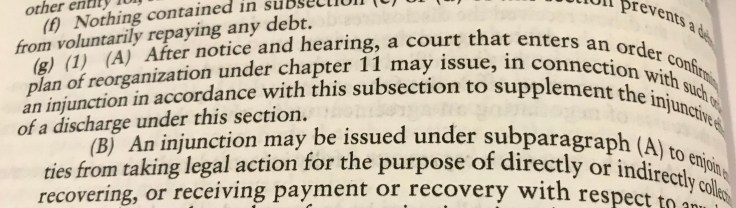
In 1994, Congress opts to follow the Manville/UNR model by amending the Bankruptcy Code to include 11 U.S.C. § 524(g), which:
- allows for resolution of asbestos claims through a trust system that is the exclusive source of compensation for all present and future asbestos claims; and
- Includes a channeling injunction that, (i) prevents any plaintiff from suing the reorganized debtor on asbestos-related claims, and (ii) channels all such claims to the trust.
Similarities between talc & asbestos claims
Like asbestos, talc exposure has generated a flood of personal injury claims over recent years, subjecting many talc companies to crushing liability.
Imerys’s business is mining, processing, and distributing talc to third-party manufacturers for use in their products.
The mass-tort experience of Imerys is typical:
- for many years, Imerys is able to tackle talc claims as they arise, through a combination of insurance assets and free cash flow; but
- by the time of its bankruptcy filing in early 2019, Imerys:
- has been sued by over 14,000 claimants; and
- can no longer afford to fight the growing mountain of claims; and
- so, it turns to Chapter 11 bankruptcy with the goal of channeling the numerous talc claims into a § 524(g) trust.[Fn. 3]
The interests of future tort claimants in the talc context are nearly identical to those of future tort claimants in the asbestos context.
And in an ironic twist, talc is alleged to contain traces of asbestos.
Conclusion
Congress needs to expand the provisions of § 524(g) to include other situations, like the mass-tort talc claims, where the interests of future claimants need protection.
————-
Footnote 1. This quote is from “Order Dismissing Bankruptcy Cases” (fn. 24, at 49) entered 6/9/2023, in 3M bankruptcy, In re Aearo Technologies LLC, et al (Case Nos. 22-02890 thru -02896) by Southern Indiana Bankruptcy Court.
Footnote 2. Historical information provided here is from In re Imerys Talc America, Inc., 38 F.4th 361, 365-67 (3d Cir. 2022).
Footnote 3. Id., 38 F.4th at 367.
** If you find this article of value, please feel free to share. If you’d like to discuss, let me know.
 MEDIATBANKRY
Leave a comment