Facilitating cultural preservation (Photo by Marilyn Swanson) “(b) Duties.—The [Subchapter V] trustee shall— . . . (7)facilitate the development of a consensual plan of reorganization.” From 11 U.S.C § 1183(b)(7)(emphasis added). Facilitation is, by statute, a duty of every Subchapter V trustee—something a Subchapter V trustee must do. But the nature and boundaries of the facilitation... Continue Reading →
Subchapter V Trustee’s Facilitation Role (Part 2)—NOT MEDIATION
Facilitating safety and relaxation (Photo by Marilyn Swanson) By: Donald L Swanson “(b) Duties.—The [Subchapter V] trustee shall— . . . (7)facilitate the development of a consensual plan of reorganization.” From 11 U.S.C § 1183(b)(7)(emphasis added). Facilitation is, by statute, a duty of every Subchapter V trustee—something a Subchapter V trustee must do. But the nature and... Continue Reading →
Subchapter V Trustee’s Facilitation Role (Part 1)—NOT NEUTRAL
Facilitating fun: a primary duty (Photo by Marilyn Swanson) By: Donald L Swanson “(b) Duties.—The [Subchapter V] trustee shall— . . . (7)facilitate the development of a consensual plan of reorganization.” From 11 U.S.C § 1183(b)(7)(emphasis added). Facilitation is, by statute, a duty of every Subchapter V trustee—something a Subchapter V trustee must do. But the nature... Continue Reading →
Beating The “Single Asset Real Estate” Exclusion From Subchapter V Eligibility (In re Evergreen)
A “single asset real estate”? (Photo by Marilyn Swanson) By: Donald L Swanson Excluded from Subchapter V eligibility is a “single asset real estate” debtor. We have a recent opinion on a Subchapter V debtor who beats that exclusion: In re Evergreen Site Holdings, Inc., [Fn. 1] What follows is a summary of that opinion. Eligibility... Continue Reading →
Trade-Off Theory: For Minimizing Debtor Benefits In Subchapter V
Trade-Off: Bait & Tackle v. Coffee & Deli (Photo by Marilyn Swanson) By: Donald L Swanson There is trade-off theory going around for construing Subchapter V statutes. The theory is used to minimize benefits that Subchapter V statutes provide to debtors. The Theory The theory goes like this: elimination of the absolute priority rule is a... Continue Reading →
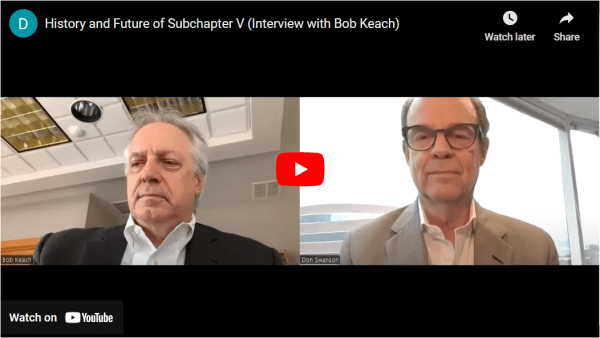
Subchapter V: Its History And Its Future (An Interview With Robert J. Keach)
https://youtu.be/J-St2KJX6rk By: Donald L Swanson Subchapter V is the newest provision of the Bankruptcy Code—becoming effective on February 19, 2020. Subchapter V arose from a Report by the American Bankruptcy Institute’s Commission to Study the Reform of Chapter 11. Here is a link to the Commission’s “Recommendations” on “Small and Medium Sized Enterprise Cases,” which establish... Continue Reading →
Shouldn’t Entrepreneurs Have After-Liquidation Bankruptcy Relief For The Risks They Take? (In re Hillman)
Entrepreneurship (Photo by Marilyn Swanson) By: Donald L Swanson Subchapter V eligibility requires a debtor to be “engaged in” commercial/business activities. Case Law Consensus Case law consensus is that such activities must exist on the petition filing date. That means a debtor cannot utilize Subchapter V when: business assets are fully-liquidated; unpaid debts are the only... Continue Reading →
Subchapter V Trustee’s “Facilitate” Duty: A Confidentiality Dilemma
A dilemma: elegance or country? (Photo by Marilyn Swanson) By: Donald L Swanson A Subchapter V Trustee “shall . . . facilitate the development of a consensual plan of reorganization.” [Fn. 1] This is a mediator-ish role: a “third party” who “participates to assist in the resolution of issues in controversy.” [Fn. 2] Subchapter V Trustee... Continue Reading →
Getting Subchapter V Trustees Paid: § 1191(e)
For love or money? (photo by Marilyn Swanson) By: Donald L Swanson Subchapter V of the Bankruptcy Code’s Chapter 11 is relatively new: it took effect as a new law on February 19, 2020. Accordingly, new questions continue to arise on how its terms and provisions should be applied. A Trustee Fees Question One Subchapter V... Continue Reading →
Guidance From Eighth Circuit BAP On Plan Feasibility Issues (Farm Credit v. Swackhammer)
Is this feasible? (Photo byMarilyn Swanson) By: Donald L Swanson Feasibility of a bankruptcy plan is always a tough issue. Think about it: debtors are in bankruptcy because they can’t make their payments when due; and in bankruptcy, a debtor must propose a plan for paying creditors—that will work this time. We now have a new... Continue Reading →