Dissenting Opinions At U.S. Supreme Court (Coinbase v. Bielski & Waleski v. Montgomery)

Dissenters? (Photo by Marilyn Swanson) By: Donald L Swanson Dissenting opinions are always interesting.  Sometimes, they are even the most interesting part of the entire case. Two recent dissents, in opinions of the U.S. Supreme Court, are decided three days apart: on June 23 & 26 of 2023, respectively. The first opinion has a four-Justices dissent... Continue Reading →

Trade-Off Theory: For Minimizing Debtor Benefits In Subchapter V

Trade-Off: Bait & Tackle v. Coffee & Deli (Photo by Marilyn Swanson) By: Donald L Swanson There is trade-off theory going around for construing Subchapter V statutes.  The theory is used to minimize benefits that Subchapter V statutes provide to debtors. The Theory The theory goes like this: elimination of the absolute priority rule is a... Continue Reading →

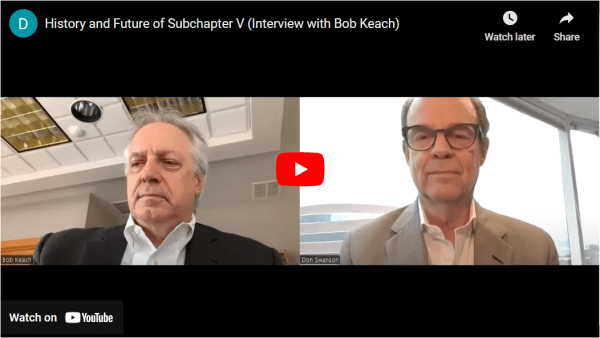
Subchapter V: Its History And Its Future (An Interview With Robert J. Keach)

https://youtu.be/J-St2KJX6rk By: Donald L Swanson Subchapter V is the newest provision of the Bankruptcy Code—becoming effective on February 19, 2020.  Subchapter V arose from a Report by the American Bankruptcy Institute’s Commission to Study the Reform of Chapter 11.  Here is a link to the Commission’s “Recommendations” on “Small and Medium Sized Enterprise Cases,” which establish... Continue Reading →

Shouldn’t Entrepreneurs Have After-Liquidation Bankruptcy Relief For The Risks They Take? (In re Hillman)

Entrepreneurship (Photo by Marilyn Swanson) By: Donald L Swanson Subchapter V eligibility requires a debtor to be “engaged in” commercial/business activities. Case Law Consensus Case law consensus is that such activities must exist on the petition filing date.  That means a debtor cannot utilize Subchapter V when: business assets are fully-liquidated; unpaid debts are the only... Continue Reading →

Guidance From Justices Gorsuch and Jackson on “Excessive Fines” Under U.S. Constitution (Tyler v. Hennepin County)

Eighth Amendment to U.S. Constitution By: Donald L Swanson “we need not decide whether she has also alleged an excessive fine under the Eighth Amendment.” --From U.S. Supreme Court’s unanimous opinion, Tyler v. Hennepin County, Minnesota, Case No. 22-166, at 14 (decided May 25, 2023). By now, everyone knows that the U.S. Supreme Court, in Tyler... Continue Reading →

Subchapter V Trustee’s “Facilitate” Duty: A Confidentiality Dilemma

A dilemma: elegance or country? (Photo by Marilyn Swanson) By: Donald L Swanson A Subchapter V Trustee “shall . . . facilitate the development of a consensual plan of reorganization.” [Fn. 1]  This is a mediator-ish role: a “third party” who “participates to assist in the resolution of issues in controversy.” [Fn. 2] Subchapter V Trustee... Continue Reading →

Sovereign Immunity In Bankruptcy: Contrasting Opinions From U.S. Supreme Court (Puerto Rico & Lac Du Flabeau Tribe)

Tribal sovereignty (photo by Marilyn Swanson) By: Donald L Swanson Contrasting opinions from any court, issued a month apart, are always instructive.  And we have a new such thing—from the U.S. Supreme Court, no less, and from May and June of this year. The contrast is on this subject: whether sovereign immunities of Puerto Rico and... Continue Reading →

3M Bankruptcy Dismissed As “Fatally Premature” (In re Aearo, et al)

Premature (Photo by Marilyn Swanson) By: Donald L Swanson “Were Congress to . . . intervene and expand § 524(g) beyond asbestos cases, bankruptcy would become a more suitable alternative for resolving mass tort cases. Until then, such cases will likely remain problematic under the Code in the face of creditor opposition.” From “Order Dismissing Bankruptcy... Continue Reading →

Getting Subchapter V Trustees Paid: § 1191(e)

For love or money? (photo by Marilyn Swanson) By: Donald L Swanson Subchapter V of the Bankruptcy Code’s Chapter 11 is relatively new: it took effect as a new law on February 19, 2020.  Accordingly, new questions continue to arise on how its terms and provisions should be applied. A Trustee Fees Question One Subchapter V... Continue Reading →

Applying Tax Refunds To Next Year’s Taxes Results In Denial Of Discharge (Miller v. Wylie)

Electing? (photo by Marilyn Swanson) By: Donald L Swanson Taxpayers can elect to have their tax refunds applied to pay their next year’s taxes. But a taxpayer in (or about to be in ) bankruptcy had better beware—doing such a thing might (or might not) result in a discharge denial.   Illustrating the issue is a... Continue Reading →

Blog at WordPress.com.

Up ↑