By: Donald L Swanson
“we need not decide whether she has also alleged an excessive fine under the Eighth Amendment.”
–From U.S. Supreme Court’s unanimous opinion, Tyler v. Hennepin County, Minnesota, Case No. 22-166, at 14 (decided May 25, 2023).
By now, everyone knows that the U.S. Supreme Court, in Tyler v. Hennepin County, declares that the Takings Clause of the U.S. Constitution prevents a local government from taking a taxpayer’s $40,000 house to satisfy a $15,000 tax debt.
Punting on the Excessive Fines Question
What’s less-known about Tyler v. Hennepin County is that the Supreme Court also granted certiorari on an excessive fine question under the U.S. Constitution’s Eighth Amendment.
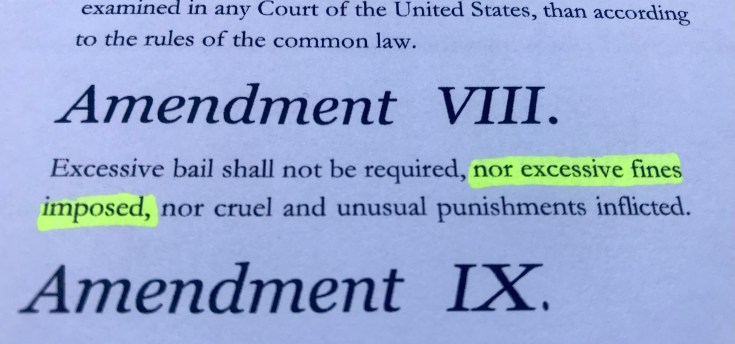
The Eighth Amendment says:
- “Excessive bail shall not be required, nor excessive fines imposed, nor cruel and unusual punishments inflicted” (emphasis added).
But the unanimous Tyler v. Hennepin County opinion punts on the Eighth Amendment’s “excessive fine” question, like this:
- “Because we find that Tyler has plausibly alleged a taking under the Fifth Amendment, and she agrees that relief under “the Takings Clause would fully remedy [her] harm’”;
- “we need not decide whether she has also alleged an excessive fine under the Eighth Amendment.”
Concurring Opinion
Justice Gorsuch and Justice Jackson offer a concurring opinion on the Eighth Amendment “excessive fine” question.
Their concurring opinion provides this set-up for their “excessive fine” discussion:
- “But even a cursory review of the District Court’s excessive-fine analysis—which the Eighth Circuit adopted as “well-reasoned” . . . —reveals that it too contains mistakes future lower courts should not be quick to emulate. (emphasis added).
What follows is a summary of three such “mistakes” discussed in the concurring opinion.
–First Mistake: Punitive v. Remedial Purpose
The District Court concludes that the Minnesota tax-forfeiture scheme is not punitive because “its primary purpose” is “remedial”—i.e., it is aimed at compensating the government for lost revenues due to the nonpayment of taxes.
Such primary-purpose test finds no support in our law:
- Since sanctions frequently serve more than one purpose, the Excessive Fines Clause applies to any statutory scheme that “serves in part to punish”;
- It matters not whether the scheme has a remedial concurring purpose, even a predominantly remedial purpose; and
- So long as the law cannot fairly be said solely to serve a remedial purpose, the Excessive Fines Clause applies (emphasis added).
Additionally, sanctions cannot be labeled “remedial” when (as here):
- they bear no correlation to any damages sustained by society or to the cost of enforcing the law; and
- any relationship between the Government’s actual costs and the amount of the sanction is merely coincidental.
–Second Mistake: Benefits to Some
The District Court says that the Minnesota tax-forfeiture scheme cannot be punitive “because it actually confers a windfall on the delinquent taxpayer when the value of the property that is forfeited is less than the amount of taxes owed.”
Such an observation may be factually true, but it is legally irrelevant. Here’s why:
- Some prisoners better themselves behind bars and some addicts credit court-ordered rehabilitation with saving their lives—but punishment remains punishment all the same;
- No one thinks that an individual who profits from an economic penalty has a winning excessive-fine claim; and
- A fine that punishes some individuals cannot escape constitutional scrutiny merely because it does not punish others.
–Third Mistake: Culpability
The District Court infers that the Minnesota scheme is not “punitive” because it does not turn on the “culpability” of the individual property owner.
Such an inference is not valid:
- While a focus on “culpability” can sometimes make a provision “look more like punishment,” this Court has never endorsed the converse view; and
- A statutory scheme may still be punitive where it serves another “goal of punishment,” such as “deterrence.”
Further, the District Court expressly approves the Minnesota tax-forfeiture scheme, in large part, because “the ultimate possibility of loss of property serves as a deterrent to those taxpayers considering tax delinquency.”
Such a basis for approving Minnesota’s scheme is wrong:
- economic penalties imposed to deter willful noncompliance with the law are fines by any other name; and
- “the Constitution has something to say about them: They cannot be excessive” (emphasis added).
Conclusion
Here’s a “Thank you” to Justice Gorsuch and Justice Jackson for the guidance they provide, in their Tyler v. Hennepin County concurring opinion, on the “excessive fines” provision of the U.S. Constitution!
** If you find this article of value, please feel free to share. If you’d like to discuss, let me know.
 MEDIATBANKRY
Leave a comment