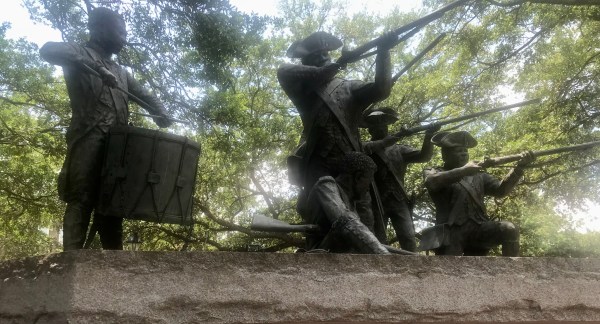
Photo is from the electronic docket for Sears bankruptcy case By Donald L. Swanson Here’s an under-appreciated fact: businesses (every one of them) face every-day risks that can destroy them. The rise and fall of the retailer, Sears, provides an illustration of the reality of such risks and how those risks ultimately prevail—even for the best... Continue Reading →
What Does “As The Court May Fix” Mean In Subchapter V? (In re Urgent Care & In re Trinity)
Can it be fixed? (Photo by Marilyn Swanson) By: Donald L Swanson 11 U.S.C. § 1191(c)(2) provides (emphasis added): “(c) . . . the condition that a plan be fair and equitable . . . includes . . . (2) . . . all of the projected disposable income of the debtor to be received in... Continue Reading →
Applying “Intent” Standard For Denying A Discharge Under § 727(a)(2) (Wylie v. Miller)
What’s the intent? (Photo by Marilyn Swanson) By: Donald L Swanson Under 11 U.S.C. § 727(a)(2), an individual debtor may be denied a discharge, in its entirely, for making a transfer “with intent to hinder, delay, or defraud” a creditor or the trustee. On April 17, 2023, the Bankruptcy Court for Eastern Michigan ruled: an “intent... Continue Reading →
Individual Debtor Discharge v. Corporate Debtor Discharge
Alive? Or a fiction? (Photo by Marilyn Swanson) By: Donald L Swanson Here are a couple discharge-related bankruptcy questions I’ve heard of late, along with an answer. Question 1. Why are individuals, but not corporations, eligible for a Chapter 7 discharge? §727(a)(1) says, “the court shall grant the debtor a discharge, unless—(1) the debtor is not... Continue Reading →
Non-Compete And Confidentiality Provisions Cannot Be Discharged—Even When The Contract Is Rejected (In re Empower)
Confidential and no competition (photo by Marilyn Swanson) By: Donald L Swanson Can non-compete and confidentiality protections in a rejected franchise agreement be discharged in bankruptcy? The answer is, “No,” according to In re Empower Central Michigan, Inc.[Fn. 1] Facts Debtor is an automotive repair shop. Debtor operates under a Franchise Agreement with Autolab Franchising, LLC. ... Continue Reading →
“Texas Two Step”: More Than A Legal Expletive? (Esserman v. Bestwall)
Uttering an expletive? (Photo by Marilyn Swanson) By: Donald L Swanson The phrase “Texas Two-Step,” as used in bankruptcy, is a legal expletive. Regardless of what the details of a Texas Two-Step might be, the phrase has become synonymous with: abusive behavior; bad faith conduct; a means for swindling creditors; the antithesis of “doing what’s right”;... Continue Reading →
A Bankruptcy / Mass Tort Dilemma For Congress To Solve (Johnson & Johnson v. Purdue Pharma)
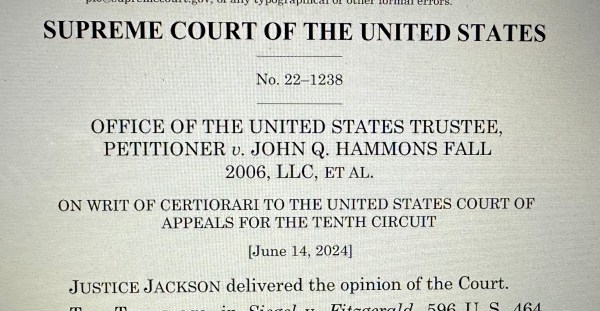
By: Donald L Swanson Here’s a dilemma: Should bankruptcy be available as a tool for resolving mass tort cases of all types (like it already is in asbestos contexts)? Here’s an illustration of the dilemma: many tort claimants in the Johnson & Johnson case DO NOT want bankruptcy involved; but many tort claimants in the Purdue... Continue Reading →
History & Progress of Subchapter V (Interview With Judge Harner)
https://youtu.be/pjbJU1cUf80 By: Donald L Swanson Hon. Michelle M. Harner is Bankruptcy Judge for the District of Maryland. Judge Harner has a long history of work on creating and implementing Subchapter V bankruptcy laws for smaller businesses. That history includes these two roles: back in 2012 through 2014, Judge Harner served as Reporter for the Commission to... Continue Reading →
What The U.S. Supreme Court Did NOT Decide: “The Outer Bounds Of § 1109(b)” (Truck Insurance)
A narrow view (photo by Marilyn Swanson) By: Donald L Swanson The U.S. Supreme Court’s opinion is Truck Insurance Exchange v. Kaiser Gypsum Co., Inc., Case No. 22-1079, Decided June 6, 2024. Opinion’s Q & A The Truck Insurance question is this: Whether an insurer with financial responsibility for a bankruptcy claim is a “party in... Continue Reading →
Conflicting Statutes: ERISA Arbitration & Bankruptcy Claims Allowance (In re Yellow Corp.)
Conflict (photo by Marilyn Swanson) By: Donald L Swanson We have a direct statutory conflict: one statute requires an ERISA dispute to be resolved in arbitration; but a bankruptcy statute requires the same dispute to be resolved in bankruptcy. Which statute should prevail? The bankruptcy statute, of course. That’s the conclusion of In re Yellow Corp.[Fn.... Continue Reading →