Can A State Receivership Court Issue A Nation-Wide Stay?

Nation-Wide By: Donald L Swanson I recently ran across an Order from a state court, under that state’s receivership statutes, purporting to create a nation-wide injunction (i.e., a “stay”) against any judicial, administrative or other action by any creditor that would affect any of the debtor’s property.  And the debtor’s property spans across state lines. My... Continue Reading →

The Need For A Uniform ABC Law

Not uniform (photo by Marilyn Swanson) By Donald L. Swanson Here are some reasons why a uniform law on the subject of assignments for benefit of creditors ("ABC") is needed. Bankruptcy Analogy The need for a uniform ABC law is the same as the need behind the “uniform” bankruptcy law requirement in the U.S. Constitution—only, it’s... Continue Reading →

ABC Statutes: Important-But-Ignored Stakeholders

Ignoring? (Photo by Marilyn Swanson) By: Donald L Swanson When state legislatures consider a legislative bill, it’s important that they hear from stakeholders who would be affected by that bill. Important ABC Stakeholders When faced with a legislative bill on assignment for benefit of creditors (“ABC”), its important that legislatures hear from a variety of stakeholders,... Continue Reading →

ABC Under The Common Law: An Out-Of-Court Tool For Liquidating Assets With Efficiency & Credibility—But With Court Assistance Available (First Bank v. Unique Marble)

A tool? (Photo by Marilyn Swanson) By:  Donald L. Swanson An assignment for benefit of creditors (an “ABC”) under the common law is an out-of-court tool for liquidating a business debtor’s assets in an efficient and credible manner.  Such a common law tool has been used, effectively and frequently, for many years in such states... Continue Reading →

Common Law ABCs v. Receiverships

The new Act By: Donald L Swanson Assignments for benefit of creditors (“ABCs”) and receiverships have been utilized effectively for centuries under the common law, side-by-side as separate and distinct and complementary remedies for liquidating assets. Differences Differences between the two are that: receiverships are a court-supervised process initiated by a creditor to dispossess the debtor... Continue Reading →

The New Uniform Assignment For Benefit Of Creditors Act Needs To Be Enacted By State Legislatures

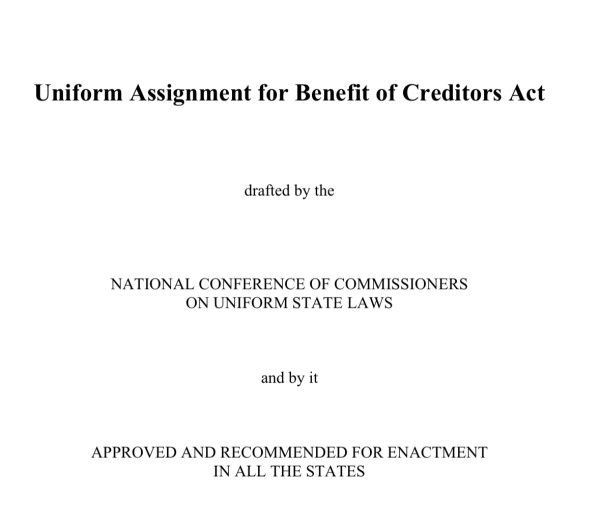
By: Donald L. Swanson On July 23, 2025, the Uniform Law Commission approved and adopted the Uniform Assignment for Benefit of Creditors Act (the “Uniform Act”) for submission to state legislatures. What follows are brief thoughts on why the Uniform Act needs to be enacted by legislatures throughout these United States as soon as possible. A... Continue Reading →

How To Maximize Value Of A Failing Debtor’s Assets—From A Secured Creditor’s Perspective

Maximizing value (photo by Marilyn Swanson) By: Donald L Swanson I’m in a discussion, recently, about this question: What are the best ways to maximize value of the assets of a failing business, from the perspective of a debtor’s primary secured creditor? The short answer is this: the best ways—by far—are debtor initiated processes; and the... Continue Reading →

The Winners In A Successful ABC: Debtor’s Secured Creditors

Winners (photo by Marilyn Swanson) By: Donald L Swanson Here’s a hypothetical. Banker is trying to manage credit problems with debtor’s failing business.  Debtor’s attorney offers banker a choice among these alternatives: Debtor could give the keys of the business to bank—to liquidate as bank sees fit; Bank could foreclose its liens; Bank could initiate a... Continue Reading →

ABCs & Bankruptcy, Part 5: Effect Of An ABC On A Pending Lawsuit–“The Most Honest Act” (Reed v. McIntyre)

By Donald L. Swanson “[T]he appellant would not have acquired priority over other creditors by the sheriff's levy, for the obvious reason that the right of property in the goods seized under the execution had previously passed” to the assignee under Debtor’s ABC. Reed v McIntyre, 98 U.S. 507, 512 (1878).  Facts The Debtor, in the... Continue Reading →

ABCs & Bankruptcy, Part 4: Are State Preference Laws Unconstitutional, Without A Knowledge Or Intent Element? (Clark v. White)

By: Donald L Swanson Here are three propositions of law, based on the U.S. Supreme Court’s Clark v. White, 13 U.S. 178 (1838), opinion: absent evidence of wrongful knowledge or intent, a creditor’s efforts at racing-to-the-courthouse to collect a debt are among the basic rights of contract that cannot be abridged by the states; state laws... Continue Reading →

Blog at WordPress.com.

Up ↑