Is the Proposed Guidance for Random Assignment in Civil Cases a Harbinger for Bankruptcy? Experts Weigh In

Reprinted with permission from the ABI Journal, Vol. XLIII, No. 5, May 2024. View the original publication here. The U.S. Judicial Conference Committee on Court Administration and Case Management proposed guidance on March 121 to promote random case assignment in civil cases (not criminal or bankruptcy cases) in districtcourts. The Judicial Conference later clarified2 that... Continue Reading →

Renewed Focus On Constitution’s Uniformity Requirement For Bankruptcy Laws (Siegel & Hammons)

Uniformity? (Photo by Marilyn Swanson) By: Donald L Swanson The bankruptcy clause of the U.S. Constitution focuses on a requirement of uniformity. Here’s the Constitution’s language: “The Congress shall have power . . . To establish . . . uniform Laws on the subject of Bankruptcies throughout the United States” [Article I, Section 8, Clause 4... Continue Reading →

Bankruptcy Code v. Federal Arbitration Act . . . & The Constitution’s Uniformity Requirement

Nonconformity (photo by Marilyn Swanson) By: Donald L Swanson Provisions of the Bankruptcy Code and the Federal Arbitration Act can collide. How those collisions are to be sorted out remains an open question. The U.S. Supreme Court recently issued an opinion on remedies for a violation of the U.S. Constitution’s uniformity requirement for bankruptcy laws[Fn. 1];... Continue Reading →

Arbitration Rights Are Now Easily Waived?! (Supreme Court’s Thomas v. Pawn American)

Waving easily (photo by Marilyn Swanson) By: Donald L Swanson Contracts can provide for the arbitration of disputes.  And those arbitration rights are enforced by the Federal Arbitration Act. But contractual arbitration rights can be waived.  And the question is this: Is it easy . . . or hard . . . to waive those rights?... Continue Reading →

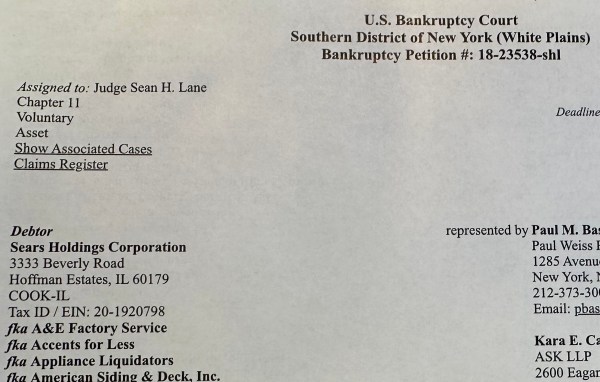
Rise And Fall of Sears: An Illustration Of Risks That Every Successful Business Faces

Photo is from the electronic docket for Sears bankruptcy case By Donald L. Swanson Here’s an under-appreciated fact: businesses (every one of them) face every-day risks that can destroy them.  The rise and fall of the retailer, Sears, provides an illustration of the reality of such risks and how those risks ultimately prevail—even for the best... Continue Reading →

What Does “As The Court May Fix” Mean In Subchapter V? (In re Urgent Care & In re Trinity)

Can it be fixed? (Photo by Marilyn Swanson) By: Donald L Swanson 11 U.S.C. § 1191(c)(2) provides (emphasis added): “(c) . . . the condition that a plan be fair and equitable . . . includes . . . (2) . . . all of the projected disposable income of the debtor to be received in... Continue Reading →

Applying “Intent” Standard For Denying A Discharge Under § 727(a)(2) (Wylie v. Miller)

What’s the intent? (Photo by Marilyn Swanson) By: Donald L Swanson Under 11 U.S.C. § 727(a)(2), an individual debtor may be denied a discharge, in its entirely, for making a transfer “with intent to hinder, delay, or defraud” a creditor or the trustee. On April 17, 2023, the Bankruptcy Court for Eastern Michigan ruled: an “intent... Continue Reading →

The “Silent” Creditor Problem In Subchapter V (In re M.V.J. Auto)

A "Silent" Participant? (Photo by Marilyn Swanson) By: Donald L Swanson A “silent” creditor in Subchapter V is one who does not vote on the debtor’s plan and does not object to that plan.  The “silent” creditor is a problem for Subchapter V cases. The Problem Here’s the problem: Subchapter V plans are prevented from being... Continue Reading →

Individual Debtor Discharge v. Corporate Debtor Discharge

Alive? Or a fiction? (Photo by Marilyn Swanson) By: Donald L Swanson Here are a couple discharge-related bankruptcy questions I’ve heard of late, along with an answer. Question 1.  Why are individuals, but not corporations, eligible for a Chapter 7 discharge? §727(a)(1) says, “the court shall grant the debtor a discharge, unless—(1) the debtor is not... Continue Reading →

Non-Compete And Confidentiality Provisions Cannot Be Discharged—Even When The Contract Is Rejected (In re Empower)

Confidential and no competition (photo by Marilyn Swanson) By: Donald L Swanson Can non-compete and confidentiality protections in a rejected franchise agreement be discharged in bankruptcy? The answer is, “No,” according to In re Empower Central Michigan, Inc.[Fn. 1] Facts Debtor is an automotive repair shop.  Debtor operates under a Franchise Agreement with Autolab Franchising, LLC. ... Continue Reading →

Blog at WordPress.com.

Up ↑