Congress Needs To Expand § 524(g) To Protect Future Claimants In Mass-Tort Cases (In re Aearo & In re Imerys)

The beginning of § 524(g) By: Donald L Swanson “Were Congress to . . . intervene and expand § 524(g) beyond asbestos cases, bankruptcy would become a more suitable alternative for resolving mass tort cases. Until then, such cases will likely remain problematic under the Code in the face of creditor opposition.” From “Order Dismissing Bankruptcy... Continue Reading →

Beating The “Single Asset Real Estate” Exclusion From Subchapter V Eligibility (In re Evergreen)

A “single asset real estate”? (Photo by Marilyn Swanson) By: Donald L Swanson Excluded from Subchapter V eligibility is a “single asset real estate” debtor. We have a recent opinion on a Subchapter V debtor who beats that exclusion: In re Evergreen Site Holdings, Inc., [Fn. 1] What follows is a summary of that opinion. Eligibility... Continue Reading →

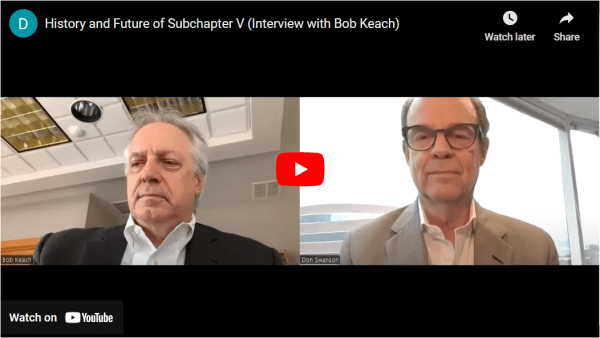
Subchapter V: Its History And Its Future (An Interview With Robert J. Keach)

https://youtu.be/J-St2KJX6rk By: Donald L Swanson Subchapter V is the newest provision of the Bankruptcy Code—becoming effective on February 19, 2020.  Subchapter V arose from a Report by the American Bankruptcy Institute’s Commission to Study the Reform of Chapter 11.  Here is a link to the Commission’s “Recommendations” on “Small and Medium Sized Enterprise Cases,” which establish... Continue Reading →

3M Bankruptcy Dismissed As “Fatally Premature” (In re Aearo, et al)

Premature (Photo by Marilyn Swanson) By: Donald L Swanson “Were Congress to . . . intervene and expand § 524(g) beyond asbestos cases, bankruptcy would become a more suitable alternative for resolving mass tort cases. Until then, such cases will likely remain problematic under the Code in the face of creditor opposition.” From “Order Dismissing Bankruptcy... Continue Reading →

Applying Tax Refunds To Next Year’s Taxes Results In Denial Of Discharge (Miller v. Wylie)

Electing? (photo by Marilyn Swanson) By: Donald L Swanson Taxpayers can elect to have their tax refunds applied to pay their next year’s taxes. But a taxpayer in (or about to be in ) bankruptcy had better beware—doing such a thing might (or might not) result in a discharge denial.   Illustrating the issue is a... Continue Reading →

Who Is A “Party in Interest”: Broad v. Narrow Construction (Truck v. Kaiser at U.S. Supreme Court)

Narrow (Photo by Marilyn Swanson) By: Donald L Swanson When a federal court approves a [bankruptcy] plan allowing someone to put its hands into another person’s pockets, the person with the pockets is entitled to be fully heard and to have legitimate objections addressed.[Fn. 1] Pop Quiz Question: Does Insurer, in the following facts, have standing... Continue Reading →

Guidance From Eighth Circuit BAP On Plan Feasibility Issues (Farm Credit v. Swackhammer)

Is this feasible? (Photo byMarilyn Swanson) By: Donald L Swanson Feasibility of a bankruptcy plan is always a tough issue. Think about it: debtors are in bankruptcy because they can’t make their payments when due; and in bankruptcy, a debtor must propose a plan for paying creditors—that will work this time. We now have a new... Continue Reading →

A Missing Piece in Subchapter V Eligibility & A Potential Work-Around

A missing piece? (Photo by Marilyn Swanson) By: Donald L Swanson One of the missing pieces in Subchapter V is this: it’s easier for a corporate business to meet the “engaged in commercial or business activities” standard for eligibility than it is for an individual owner/guarantor of that business. Here’s how one court describes the missing... Continue Reading →

Subchapter V: Providing Hope To Formerly Successful Entrepreneurs

Hope?! (photo by Marilyn Swanson) By: Donald L Swanson The Bankruptcy Code's Subchapter V provides hope to formerly successful entrepreneurs. It's a hope that never before existed. I'll try to explain. Formerly Successful Entrepreneurs – A Historical Problem The Bankruptcy Code became effective in October of 1979. And I’ve been practicing under the Bankruptcy Code from... Continue Reading →

Working Together: A Previously Successful Business’s General Counsel and Distressed-Debt Counsel

Working together? (photo by Grant Swanson) By: Donald L Swanson Answers to these two questions can get tricky: When should a previously successful business engage distress-debt counsel? What is the role of the business’s general counsel once that happens? Second Question: Role Here’s the answer to the second question first:  The business’s general counsel needs to... Continue Reading →

Blog at WordPress.com.

Up ↑