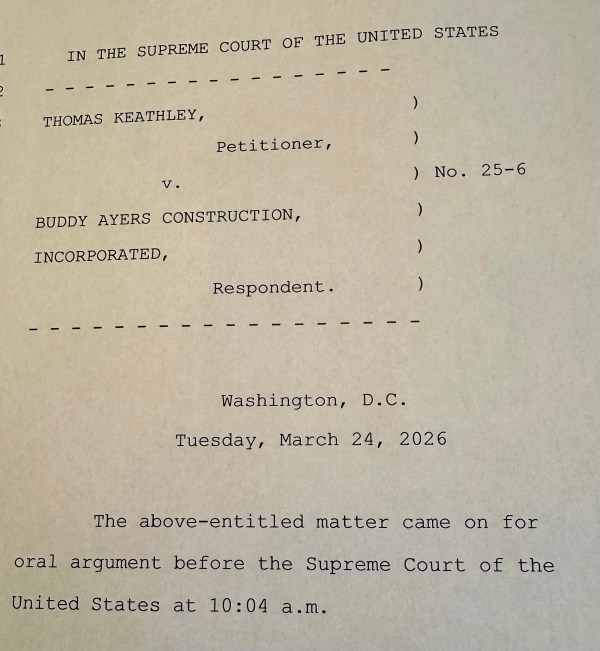
Estopped? (photo by Marilyn Swanson) By: Donald L Swanson A Petition for Writ of Certiorari has been granted by the U.S. Supreme Court in Keathley v. Buddy Ayers Construction, Inc., Case No. 25-6, on a ruling from the U.S. Fifth Circuit Court of Appeals.[Fn. 1] The Question Presented in Kethley v. Buddy Ayers is this: “Whether... Continue Reading →
Contracts To Make “Financial Accommodations” Cannot Be Assumed Or Assigned—§ 365(c)(2) (In re Svenhard)
Accommodating? (Photo by Marilyn Swanson) By: Donald L Swanson 11 U.S.C. § 365(c)(2) says (emphasis added): “(c) The trustee may not assume or assign any executory contract or unexpired lease of the debtor . . . , if— . . . (2) such contract is a contract to make a loan, or extend other debt financing... Continue Reading →
Fraudulent Conveyance & § 510(b) Subordination (Phillips v. Josmic)
A powerful conveyance (photo by Marilyn Swanson) By: Donald L Swanson Here’s a new issue—at least for me: a combination of fraudulent conveyance law & § 510(b) subordination addressed in: Phillips v. Josmic 2 LLC (ONH AFC CS Investors, LLC), Adv. Proc. No. 24-50085, Delaware Bankruptcy Court (decided May 8, 2025). The Issue At common law,... Continue Reading →
ABCs & Unsecured Trade Creditors
An unsecured trade creditor? (Photo by Marilyn Swanson) By: Donald L Swanson Here's a question about the new Uniform Assignment for Benefit of Creditors Act (the “Uniform ABC Act”): Is a liquidation under the Uniform ABC Act a good thing or a bad thing for the debtor’s unsecured trade creditors? The answer is easy: it’s a... Continue Reading →
Bankruptcy Court Authority And “Personal Injury Tort” Claims? (Arrieta v. Smith)
A place of authority? (Photo by Marilyn Swanson) By: Donald L Swanson 28 U.S.C. § 157(b)(5) provides: “personal injury tort and wrongful death claims shall be tried in the district court in which the bankruptcy case is pending, or in the district court in the district in which the claim arose” In other words, “personal injury... Continue Reading →
U.S. Government’s Bias On Bankruptcy Cases (Hertz v. Wells Fargo)
Even-handed? (photo by Marilyn Swanson) By: Donald L Swanson The U.S. Supreme Court does not like the Bankruptcy Code. It never has. Two examples are: in Northern Pipeline v. Marathon Pipe Line (1982), the Supreme Court comes within one vote of declaring the entire Bankruptcy Code unconstitutional—and while it fails to deal the Code a mortal... Continue Reading →
Justice Delayed For Mass Tort Survivors (Boy Scouts)
Delays? (photo by Marilyn Swanson) By: Donald L Swanson Mass torts and resulting litigation are a reality of life in these United States. But one of the truly shocking things about mass tort litigation, in recent times, is this: judicial delays override the wishes of mass tort victims for prompt payment of negotiated amounts. A current... Continue Reading →
Advisory Opinion On An Issue Resolved By Stipulation Of The Parties (In re Whittaker—Part 5)
By: Donald L Swanson Here’s a curious thing: an advisory opinion from a U.S. Circuit Court of Appeals on an issue for which there is no controversy and that is mostly academic. That’s exactly what we have in In re Whittaker Clark & Daniels, Inc., Case Nos. 24-2210 & 24-2211 (3rd Cir., decided September 10, 2025)(see... Continue Reading →
Can Bankruptcy Courts Ever Create a Federal Common Law Choice-Of-Law-Rule? (In re Whittaker–Part 4)
By: Donald L Swanson It’s not every day that the author of a Circuit Court opinion also authors a concurring opinion. But that’s exactly what happens here: In re Whittaker Clark & Daniels, Inc., Case Nos. 24-2210 & 24-2211 (3rd Cir., decided September 10, 2025).## Overview The issue in the concurring opinion deals with this question:... Continue Reading →
Equitable Tolling & Nondischargeability Filing Deadline (In re Osborn)
A place of equity? (Photo by Marilyn Swanson) By: Donald L Swanson I recently published this linked article on equitable tolling of a deadline for filing a dischargeability complaint or a motion to extend that deadline: Equitable Tolling & Due Process for Dischargeability Deadlines (TL90108 v. Ford). Here’s another opinion on that same subject with an... Continue Reading →