ABC Under The Common Law: An Out-Of-Court Tool For Liquidating Assets With Efficiency & Credibility—But With Court Assistance Available (First Bank v. Unique Marble)

A tool? (Photo by Marilyn Swanson) By:  Donald L. Swanson An assignment for benefit of creditors (an “ABC”) under the common law is an out-of-court tool for liquidating a business debtor’s assets in an efficient and credible manner.  Such a common law tool has been used, effectively and frequently, for many years in such states... Continue Reading →

Advisory Opinion On An Issue Resolved By Stipulation Of The Parties (In re Whittaker—Part 5)

By: Donald L Swanson Here’s a curious thing: an advisory opinion from a U.S. Circuit Court of Appeals on an issue for which there is no controversy and that is mostly academic. That’s exactly what we have in In re Whittaker Clark & Daniels, Inc., Case Nos. 24-2210 & 24-2211 (3rd Cir., decided September 10, 2025)(see... Continue Reading →

Common Law ABCs v. Receiverships

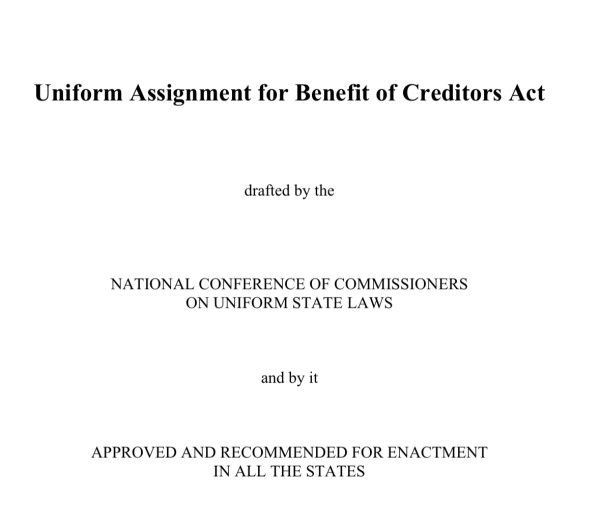
The new Act By: Donald L Swanson Assignments for benefit of creditors (“ABCs”) and receiverships have been utilized effectively for centuries under the common law, side-by-side as separate and distinct and complementary remedies for liquidating assets. Differences Differences between the two are that: receiverships are a court-supervised process initiated by a creditor to dispossess the debtor... Continue Reading →

Can Bankruptcy Courts Ever Create a Federal Common Law Choice-Of-Law-Rule? (In re Whittaker–Part 4)

By: Donald L Swanson It’s not every day that the author of a Circuit Court opinion also authors a concurring opinion. But that’s exactly what happens here: In re Whittaker Clark & Daniels, Inc., Case Nos. 24-2210 & 24-2211 (3rd Cir., decided September 10, 2025).## Overview The issue in the concurring opinion deals with this question:... Continue Reading →

Receiverships v. Bankruptcies = The Wild West v. The Rule Of Law

The wild west (photo by Grant Showalter-Swanson) By: Donald L Swanson When comparing proceedings under the Bankruptcy Code with receivership proceedings under state law, there is a similarity: both require intensive court supervision. And there is a huge difference: bankruptcy provides precise rules—lots of them—under an extensive Code and accompanying national and local rules and a... Continue Reading →

Equitable Tolling & Nondischargeability Filing Deadline (In re Osborn)

A place of equity? (Photo by Marilyn Swanson) By: Donald L Swanson I recently published this linked article on equitable tolling of a deadline for filing a dischargeability complaint or a motion to extend that deadline: Equitable Tolling & Due Process for Dischargeability Deadlines (TL90108 v. Ford). Here’s another opinion on that same subject with an... Continue Reading →

“Abuses Of Receiverships”—A Problem From The Late 1800s And Early 1900s

Built circa 1891 (photo by Marilyn Swanson) By: Donald L Swanson Here is an article from more than a century ago: Jacob Trieber, Abuses of Receiverships,”  37 Yale L.J. 275-279 (1909).  What follows is a summary of that article. Receivership—A Judicial Remedy Receivership is a judicial remedy to preserve a fund or property from spoliation, waste... Continue Reading →

Failing To Prove “Intent” For “Embezzlement” Discharge Exception (In re Parker)

Intent? (Photo by Marilyn Swanson) By:  Donald L. Swanson Here’s a refresher on the law of nondischargeability for “embezzlement” under § 523(a)(4): Martin v. Parker (In re Parker), Case No. 23-2084 (4th Cir., decided July 1, 2025). Facts Morton and Peggy cohabit for years without marrying.  But they do sign a “Post Marital Agreement,” under... Continue Reading →

What Happens To A Tort Claim Upon Abandonment By The Chapter 7 Trustee? (Martineu v. Wier)

What happens to a rainbow? (Photo by Marilyn Swanson) By: Donald L. Swanson When a Chapter 7 bankruptcy trustee abandons the debtor’s tort claims, what happens to those tort claims? Such question is addressed in a recent opinion of the U.S. Fourth Circuit Court of Appeals,[fn. 1] by describing a prior bankruptcy ruling (Martineau v. Wier,... Continue Reading →

Fraudulent Transfer: What Does “Reasonably Equivalent Value” Mean? (In re White)

Are they all "reasonably equivalent"? (Photo by Marilyn Swanson) By: Donald L Swanson The opinion is Bird v. Wardley (In re White), Case No. 24-4033 (10th Cir., decided July 22, 2025). It addresses the meaning of the phrase “reasonably equivalent value” in the Uniform Fraudulent Transfer Act. Facts The In re White Debtor creates a start-up... Continue Reading →

Blog at WordPress.com.

Up ↑