By: Donald L Swanson
On February 27, 2026, the Nebraska Unicameral Legislature passed the Uniform Assignment for Benefit of Creditors Act (LB 783) by unanimous vote, and on March 3, 2026, the Governor signed it into law. See this link.
In honor of that event, here is some Nebraska history, under a set of assignment for benefit of creditors (“ABC”) statutes, contained in Chapter 6 of Nebraska Revised Statutes and repealed in 1945.
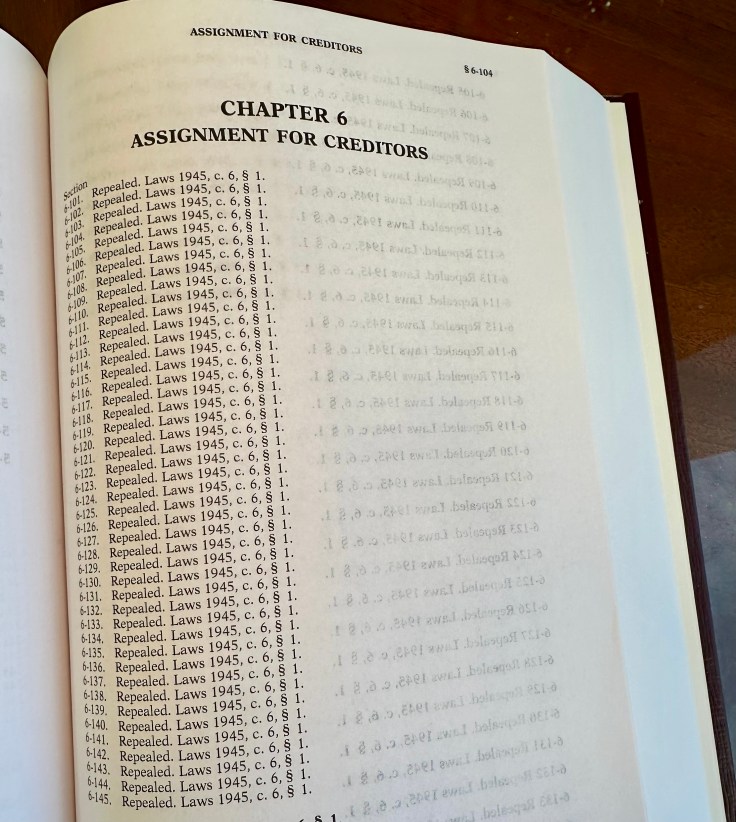
- See photo above for how such Chapter 6 appeared after 1945 and until Nebraska’s enactment of the Uniform Assignment for Benefit of Creditors Act.
Lancaster County Bank v. Horn
In 1892, the Nebraska Supreme Court ruled that, once a valid ABC assignment happens under state law, creditors of the ABC assignor can no longer attach the assigned assets.
- The opinion is Lancaster County Bank v. Horn, 34 Neb. 742, 52 N.W. 562 (1892).
What follows is a summary of that bit of ABC history.
Nebraska ABC Statutes
Under Nebraska’s ABC statutes in effect in the late 1800s, the process worked like this:
- all debtor’s assets would be assigned, initially, to the sheriff of the county in which the debtor resides; and
- debtor’s creditors could, thereafter, select a different person to replace the Sheriff as the ABC assignee.
Facts
Debtor makes an ABC assignment of all Debtor’s property to the Sheriff of Lancaster County, Nebraska, by a written deed of assignment.
The assets assigned are personal property only (no real property is involved), so the Sheriff promptly files the assignment deed with the county clerk.
Thereafter, a judgment plaintiff obtains an order of attachment from a state court against Debtor’s assets (the same personal property assets that had already been assigned to the Sheriff).
Then, the attachment order is placed in the hands of the same Sheriff of Lancaster County, Nebraska, who promptly:
- levies on the same personal property that the Sheriff holds as ABC assignee, and
- asks the state court for instructions on what to do with the competing ABC and attachment claims.
State Court Proceedings
After a hearing on the Sheriff’s request for instructions, the state court makes the following findings:
- on October 30, 1891, there was delivered to the Sheriff, as the initial ABC assignee, a written deed of assignment of various articles of personal property, duly executed and acknowledged by Debtor;
- within twenty-four hours thereafter the Sheriff, as ABC assignee, files the said deed of assignment with the county clerk as required by section 6, chapter 6, of the Compiled Statutes of 1889, entitled “Assignments”; and
- on November 19, 1891, a writ of attachment issues, and the Sheriff promptly, as commanded by said writ, levies on the same property that is held by the Sheriff as ABC assignee.
The state court then declares:
- the only question before the court is whether Debtor’s ABC assignment of personal property should have been filed with, (i) the register of deeds, or (ii) with the county clerk, where in fact the sheriff did file it; and
- since the assignment involved personal property only (and no real property), it was properly filed with the county clerk.
The state court then concludes and orders that, since the ABC deed of assignment was properly filed,
- the ABC assignment is valid; and
- the subsequent attachment cannot be sustained.
Meanwhile, Debtor’s creditors have selected another person to serve as the replacement ABC assignee. So, the state court also orders that, “the Sheriff is directed to turn over” the assigned assets to the replacement ABC assignee chosen by creditors.
Appeal to Nebraska Supreme Court
The judgment creditor appeals, and the Nebraska Supreme Court affirms because nothing in Nebraska’s statutes required the filing of a deed of assignment of personal property in the register of deeds for real property.[Fn. 1]
Similar Opinion from U.S. Supreme Court
The Nebraska Supreme Court could have, but didn’t, cite this U.S. Supreme Court opinion on the same point: Reed v McIntyre, 98 U.S. 507, 512 (1878), which says:
- “the appellant would not have acquired priority over other creditors by the sheriff’s levy, for the obvious reason that the right of property in the goods seized under the execution had previously passed, by a valid and unimpeachable deed, to Combs [the Assignee in Debtor’s ABC], and they were not thereafter subject to execution as the property of the debtor.”
Conclusion
It’s always fascinating to see items of history, like the Lancaster County Bank v. Horn opinion, that presage rules of law that remain valid and in effect into the present time.
——————-
Footnote 1. The Lancaster County Bank v. Horn opinion is reversed on other grounds in this subsequent Nebraska Supreme Court opinion, which deals with a defective ABC assignment: Sager v. Summers, 49 Neb. 459, 68 N.W. 614 (1896).
** If you find this article of value, please feel free to share. If you’d like to discuss, let me know.
 MEDIATBANKRY
Don,
Congratulations on the enactment of the ABC Act in Nebraska – first in the nation! We’ve started working on the process here in California. Thank you for this very interesting post.
Kind regards,
Jim Hayes (Official Observer ULC)
Western State College of Law at Westcliff University
15505 Red Hill Avenue,
Tustin, California
LikeLike
Thanks, Jim. Best of luck on the ABC Act in California!
LikeLike